Showing posts sorted by relevance for query Geraldine Farrar. Sort by date Show all posts

22 May 2020

Imported from the USA: Geraldine Farrar

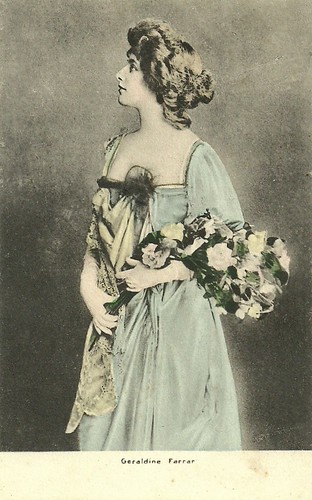
American soprano opera singer and film actress Geraldine Farrar (1882-1967) was noted for her glamorous beauty, acting ability, and the timbre of her voice. Barely 20, she was already the toast of Berlin. Later at the Met in New York, she had a large following among young women, nicknamed ‘Gerry-flappers’. Farrar also starred in over a dozen silent films from 1915 to 1920. She was married to and co-starred with Dutch matinee idol Lou Tellegen.
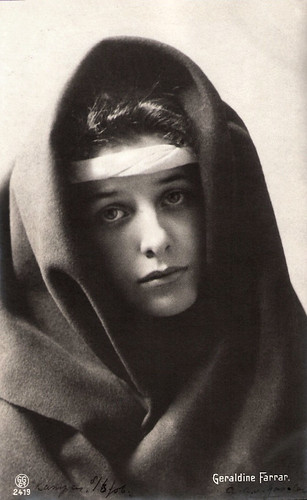
Geraldine Farrar
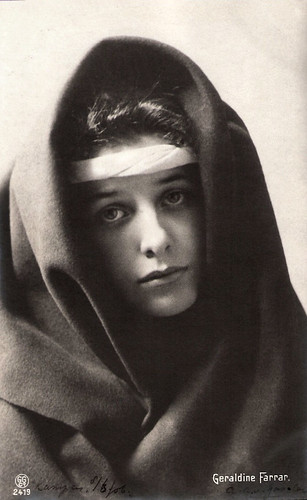
German postcard by G.G. & Co., no. 2419.

Geraldine Farrar as Angela in Le Domino Noir (1905)
German postcard by Photochemie, Berlin, no. 251. Photo: Zander und Labisch. Geraldine Farrar as Angela in 'Le Domino Noir' (1905).
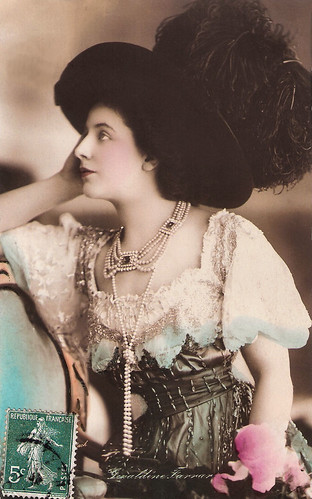
Geraldine Farrar
French postcard.

Geraldine Farrar
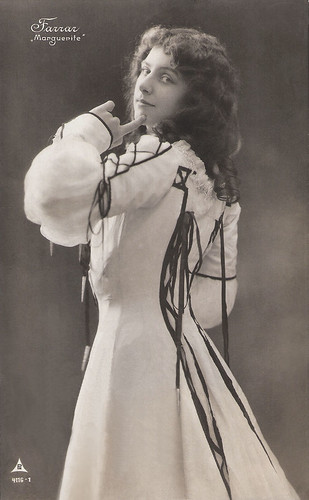
German postcard by PH, no. 4116/1. Geraldine Farrar as Marguerite in Charles Gounod's opera Faust.

Geraldine Farrar
Swedish postcard by Förlag Nordisk Konst, Stockholm, no. 936. Photo: Skandinavisk Film-Central, Stockholm.

Gerry-flappers


Alice Geraldine Farrar was born in Melrose, Massachusetts, in 1882. She was the daughter of baseball player Sidney Farrar, and his wife, Henrietta Barnes. At 5 she began studying music in Boston and by 14 was giving recitals. Later she studied voice with the American soprano Emma Thursby in New York City, in Paris, and finally with the Italian baritone Francesco Graziani in Berlin.

In 1901, Farrar created a sensation at the Berlin Hofoper with her debut as Marguerite in Charles Gounod's 'Faust'. She remained with the company for three years, while she continued her studies with legendary Wagnerian soprano Lilli Lehmann. Farrar appeared in the title roles of Ambroise Thomas' 'Mignon' and Jules Massenet's 'Manon', as well as Juliette in Charles Gounod's 'Roméo et Juliette'.

Her admirers in Berlin included Crown Prince Wilhelm of Germany, with whom she is believed to have had a relationship beginning in 1903. This Berlin period was interspersed with three seasons with the Monte Carlo Opera. Highlights were Pietro Mascagni's 'Amica' (1905), and Giuseppe Verdi's 'Rigoletto' (1906) in which she appeared with Enrico Caruso. That year, she debuted at the New York Metropolitan Opera in 'Romeo et Juliette' (1906). The success placed her on a plateau with Caruso as a box-office magnet. The next year, she got raves for her performance as Cio-Cio-San in the Metropolitan premiere of Giacomo Puccini's 'Madama Butterfly' in 1907.

Farrar remained a company member until her retirement in 1922, singing 29 roles there in 672 performances. She developed a large following, especially among New York's young female opera-goers, known as Gerry-flappers. Farrar created the title roles in Puccini's 'Suor Angelica' (1918), Umberto Giordano's 'Madame Sans-Gêne' (1915), as well as the Goosegirl in Engelbert Humperdinck's 'Königskinder' (1910), for which Farrar trained her own flock of geese. According to a New York Tribune review of the first performance, "at the close of the opera, Miss Farrar caused 'much amusement' by appearing before the curtain with a live goose under her arm."

Her biographer Elizabeth Nash adds: “Unlike most of the famous bel canto singers of the past who sacrificed dramatic action to tonal perfection, she was more interested in the emotional than in the purely lyrical aspects of her roles.”
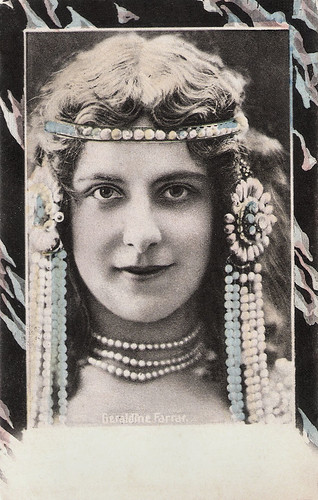
Geraldine Farrar
German postcard by K.V.i.B., Dess, no. 1016.
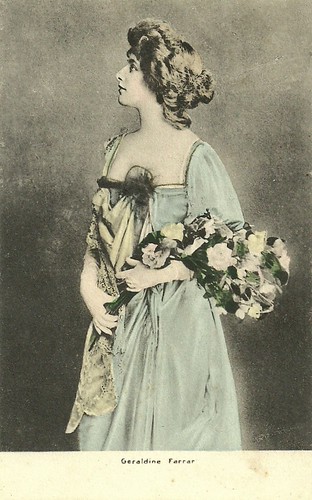
Geraldine Farrar
German postcard by K.V.i.B. 12. Dess., no. 4017.
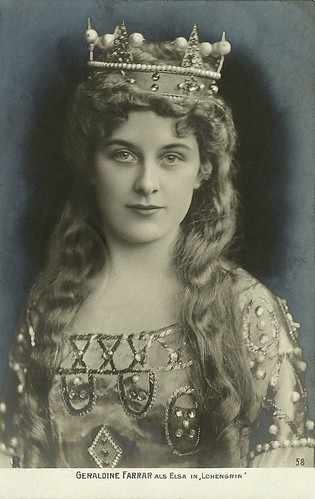
Geraldine Farrar
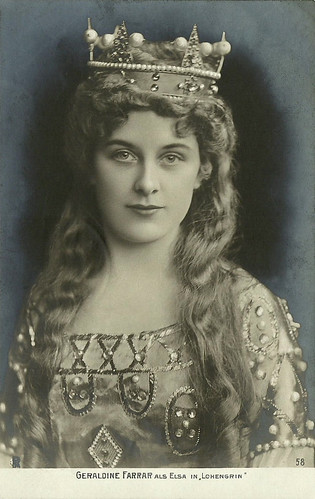
Vintage postcard, no. 58. Photo: Geraldine Farrar as Elsa in Lohengrin. Collection: Didier Hanson.
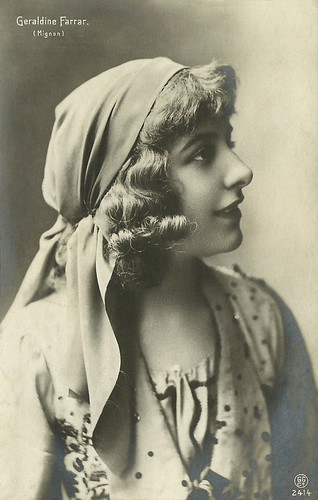
Geraldine Farrar
German postcard by G.G. & Co., no. 2414. Photo: publicity still for Mignon. Collection: Didier Hanson.
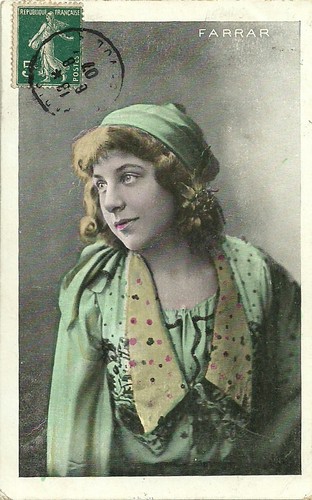
Geraldine Farrar
French postcard. Editor unknown. Postcard sent in 1907. Geraldine Farrar in the opera Mignon.
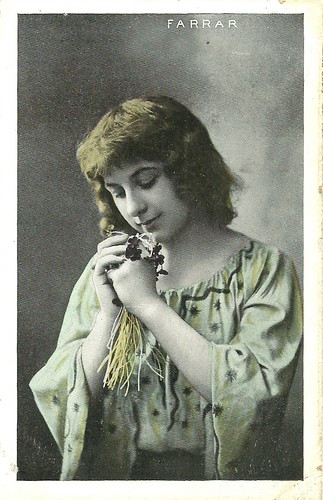
Geraldine Farrar
French postcard.

Cecil B. De Mille


Geraldine Farrar recorded extensively for the Victor Talking Machine Company and was often featured prominently in that firm's advertisements. She was one of the first performers to make a radio broadcast, in a 1907 publicity event singing over Lee De Forest's experimental AM radio transmitter in New York City.

She also starred in more than a dozen silent films from 1915 to 1920, filmed between opera seasons. Farrar debuted with the title role in Cecil B. De Mille's Carmen (1915), based on the novella Carmen by Prosper Mérimée. For her role as the seductive gipsy girl, she was extensively praised. For her performance, she came in fourth in the 1916 Screen Masterpiece contest held by Motion Picture Magazine, ahead of any other actress. DeMille directed her next in the silent romantic drama Temptation (Cecil B. DeMille, 1915), also with Theodore Roberts, and in the drama Maria Rosa (Cecil B. DeMille, 1916) with Wallace Reid.

Another notable screen role was as Joan of Arc in Joan the Woman (1917). This was Cecil DeMille's first historical drama. The screenplay is based on Friedrich Schiller's 1801 play 'Die Jungfrau von Orleans' (The Maid of Orleans). She next played the daughter of an Aztec king in the silent romance The Woman God Forgot (Cecil B. DeMille, 1917). In the film, she falls in love with a Spanish captain (Wallace Reid) whose army has come to convert the Aztecs to Christianity. Her last film for Paramount Pictures was the romance The Devil-Stone (Cecil B. DeMille, 1917), again with Wallace Reid. The film had sequences filmed in the Handschiegl Color Process, but only two of six reels are known to survive.

For Goldwyn Pictures, she appeared in such films as The Turn of the Wheel (Reginald Barker, 1918) with Herbert Rawlinson and Percy Marmont, the Western The Hell Cat (Reginald Barker, 1918), Shadows (Reginald Barker, 1918) and the melodrama The Stronger Vow (Reginald Barker, 1919), the latter three with Milton Sills. All four films are considered lost.

She co-starred with her husband Lou Tellegen in the dramas The World and Its Woman (Frank Lloyd, 1919), Flame of the Desert (Reginald Barker, 1919), and The Woman and the Puppet (Reginald Barker, 1920). Her final film was the silent drama The Riddle: Woman (Edward José, 1920), in which her co-star was Montagu Love.

Geraldine Farrar
Spanish card by La Novela Semanal Cinematográfica, no. 109.

Geraldine Farrar (1x Etoile Reutlinger) 195, 1907
French postcard by Etoile, Paris, no. 195. Photo: Reutlinger.

Geraldine Farrar in Madam Butterfly
German postcard by GG Cie, no. 5050. Geraldine Farrar as Madam Butterfly.
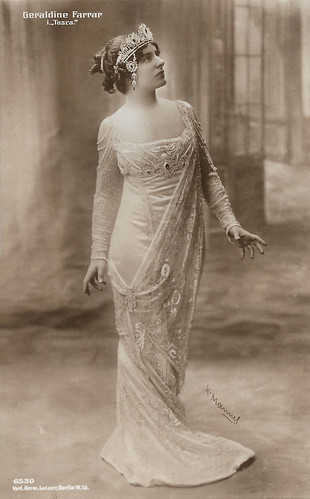
Geraldine Farrar in Tosca
German postcard by Verlag Herm. Leiser, Berlin, no. 6530. Photo: H. Manuel. Geraldine Farrar in the opera 'Tosca'.
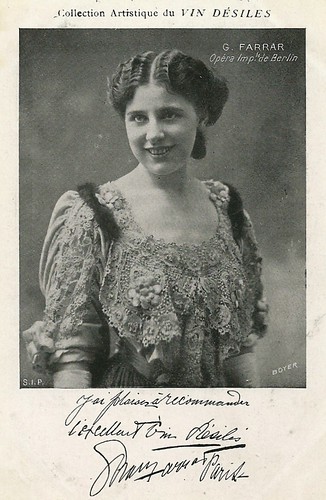
Geraldine Farrar
French postcard. Publicity for Vins Désiles. Photo SIP, Boyer. G. Farrar de l'Opéra Impéraile de Berlin. Caption: J'ai plaisir à recommander l'excellent Vin Désiles (I enjoy recommending the excellent Vin Désiles).

A messy and very public divorce


Geraldine Farrar had a seven-year love affair with the Italian conductor Arturo Toscanini. It was rumoured that she gave him an ultimatum to choose either her or his wife and children in Italy. It resulted in Toscanini's abrupt resignation as principal conductor of the Metropolitan Opera in 1915. Farrar was close friends with the star tenor Enrico Caruso and there has been speculation that they too had a love affair, but no conclusive evidence has surfaced.

In 1916, she married Dutch film actor Lou Tellegen. Their marriage was the source of considerable scandal, and it ended, as a result of her husband's numerous affairs, in a messy and very public divorce in 1923. The circumstances of the divorce were brought again to public recollection by Tellegen's bizarre 1934 suicide in Hollywood. When told of her ex-husband's death, she replied "Why should that interest me?"

Farrar retired from opera in 1922 at the age of 40. Her final performance was as Ruggero Leoncavallo's Zazà. By this stage, her voice was in premature decline due to overwork. Farrar quickly transitioned into concert recitals and was signed within several weeks of announcing her opera retirement to an appearance at Hershey Park on Memorial Day 1922.

She continued to make recordings and give recitals throughout the 1920s and was briefly the intermission commentator for the Metropolitan Opera radio broadcasts during the 1934–1935 season. Her rather bizarre autobiography, Such Sweet Compulsion (1938), was written in alternating chapters purporting to be her own words and those of her mother, with Mrs. Farrar rather floridly recounting her daughter's many accomplishments.

In 1967, Geraldine Farrar died in Ridgefield, Connecticut of heart disease aged 85, and was buried in Kensico Cemetery in Valhalla, New York. She had no children. Dutch author Susan Smit published an excellent biographical novel about Farrar and her great love Lou Tellegen, 'De eerste vrouw' (The First Woman).

Geraldine Farrar AE 2513-3
Swedish postcard by AE (Axel Eliassons Konstförlag, Stockholm), no. 2513-3.

Geraldine Farrar, AE 8513 - 5
Swedish postcard by AE (Axel Eliassons Konstförlag, Stockholm), no. 2513-5. The swan may refer to the opera 'Lohengrin' by Richard Wagner.
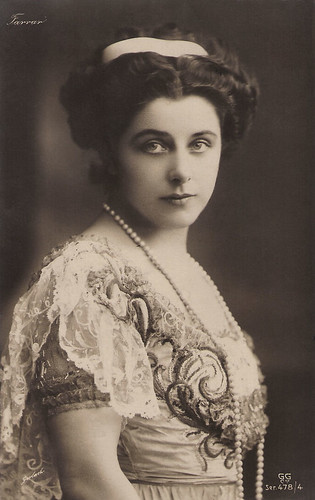
Geraldine Farrar
German postcard G.G. & Co., no. 478/4. Photo: Gerlach.
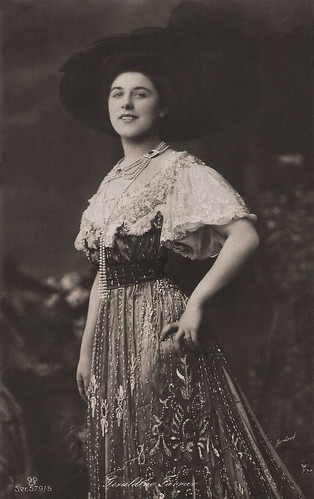
Geraldine Farrar
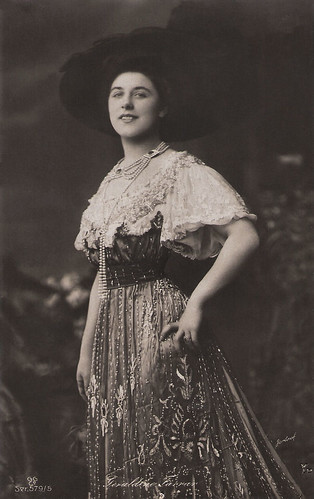
German postcard G.G. & Co., no. 579/5. Photo: Gerlach.
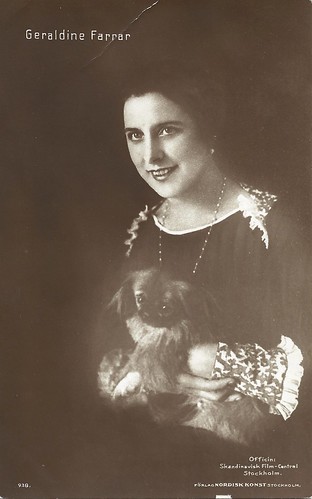
Geraldine Farrar
Swedish postcard by Förlag Nordisk Konst, Stockholm, no. 938. Photo: Skandinavisk Film-Central, Stockholm.

Susan Smit, De eerste vrouw
Book cover for Susan Smit, 'De eerste vrouw' (2016). Publisher: Lebowski.

Sources: Andrea Suhm-Binder (Cantabile subito), Bob Hufford (Find A Grave), Wikipedia and IMDb.

This post was last updated on 2 March 2024.

05 September 2019

A passionate love doomed to fail

In the last post in our summer series on recent film books, EFSP has another Dutch curiosity. A novel about a legendary diva of the international opera houses who had vowed never to marry, who meets a heartbreaker with the angelic face that caused a furore on the stage. In 'De eerste vrouw' (The First Woman, 2016), Susan Smit depicts the tumultuous and love story between the American Geraldine Ferrar and the Dutchman Lou Tellegen, who starred together in three silent Hollywood films. Smit based her exciting novel on historical factual material.

Susan Smit, De eerste vrouw
Book cover for Susan Smit, 'De eerste vrouw' (2016). Publisher: Lebowski, Amsterdam.

Geraldine Farrar
German postcard by G.G. & Co., no. 478/4. Photo: Gerlach.

Geraldine Farrar
German postcard by G.G. & Co., no. 579/5. Photo: Gerlach.

Geraldine Farrar
German postcard by G.G. & Co., no. 2414. Photo: Photo: Geraldine Farrar as Mignon in the opera 'Mignon'. Collection: Didier Hanson.

Geraldine Farrar
German postcard by G.G. & Co., no. 2419.

The toast of Berlin


Susan Smit unfolds in 'De eerste vrouw' the love story in two parts. First she tells about the years before Hollywood, in alternating chapters on the careers and lifes of 'Lou' and 'Geraldine'. At the end the two meet at an elegant party in Holland House in New Tork. They immediately fall in love.

Alice Geraldine Farrar (1882-1967) had always been noted for her glamorous beauty, her acting talent, and the timbre of her voice. At 5 she already began studying music in Boston and by 14 was giving recitals. Barely 20, she was the toast of Berlin.

Farrar had created a sensation in 1901 at the Berlin Hofoper with her debut as Marguerite in Charles Gounod's 'Faust'. She remained with the company for three years, during which time she appeared in the title roles of Ambroise Thomas' 'Mignon' and Jules Massenet's 'Manon', as well as Juliette in Gounod's 'Roméo et Juliette'. Her admirers in Berlin included Crown Prince Wilhelm of Germany, with whom she is believed to have had a relationship beginning in 1903.

This Berlin period was interspersed with three seasons with the Monte Carlo Opera. Highlights were Pietro Mascagni's 'Amica' (1905), and Giuseppe Verdi's 'Rigoletto' (1906) in which she appeared with Enrico Caruso. In 1906, she also made her debut at the New York Metropolitan Opera in 'Roméo et Juliette'. The success placed her on a plateau with Caruso as a box-office magnet. The next year, she got raves for her performance as Cio-Cio-San in the Metropolitan premiere of Giacomo Puccini's 'Madama Butterfly' in 1907.

Geraldine Farrar had a seven-year love affair with the Italian conductor of the Met, Arturo Toscanini. It was rumored that she gave him an ultimatum that he must choose either her or his wife and children in Italy. It resulted in Toscanini's abrupt resignation as principal conductor of the Metropolitan Opera in 1915. Farrar was close friends with star tenor Enrico Caruso and there has been speculation that they too had a love affair, but no conclusive evidence of this has surfaced. At the Met, Farrar had a large following among young women, who were nicknamed ‘Gerry-flappers’. Farrar created the title roles in Puccini's 'Suor Angelica' (1918), Umberto Giordano's 'Madame Sans-Gêne' (1915), as well as the Goosegirl in Engelbert Humperdinck's 'Königskinder' (1910).

Her biographer Elizabeth Nash: “Unlike most of the famous bel canto singers of the past who sacrificed dramatic action to tonal perfection, she was more interested in the emotional than in the purely lyrical aspects of her roles.” Farrar remained a member of the company until her retirement in 1922, singing 29 roles there in 672 performances.

Geraldine Farrar also starred in more than a dozen silent films from 1915 to 1920, which were filmed between opera seasons. Farrar made her debut with the title role in Cecil B. De Mille's Carmen (1915), based on the novella 'Carmen' by Prosper Mérimée. For her role as the seductive gypsy girl she was extensively praised. DeMille directed her next in the silent romantic drama Temptation (Cecil B. DeMille, 1915), also with Theodore Roberts, and in the drama Maria Rosa (Cecil B. DeMille, 1916) with Wallace Reid.

Another notable screen role was as Joan of Arc in Joan the Woman (1917). This was Cecil B. DeMille's first historical drama. The screenplay is based on Friedrich Schiller's 1801 play 'Die Jungfrau von Orleans' (The Maid of Orleans).

She next played the daughter of an Aztec king in the silent romance The Woman God Forgot (Cecil B. DeMille, 1917). In the film she falls in love with a Spanish captain (Wallace Reid) whose army has come to convert the Aztecs to Christianity. Her last film for Paramount Pictures was the romance The Devil-Stone (Cecil B. DeMille, 1917), again with Wallace Reid. The film had sequences filmed in the Handschiegl Color Process, but only two of six reels are known to survive.

For Goldwyn Pictures, she appeared in such films as The Turn of the Wheel (Reginald Barker, 1918) with Herbert Rawlinson and Percy Marmont, the Western The Hell Cat (Reginald Barker, 1918), Shadows (Reginald Barker, 1918) and the melodrama The Stronger Vow (Reginald Barker, 1919), the latter three with Milton Sills. All four films are considered lost.

Geraldine Farrar
Vintage postcard, no. 58. Photo: Geraldine Farrar as Elsa in the opera 'Lohengrin'by Richard Wagner. Collection: Didier Hanson.

Geraldine Farrar in Tosca
German postcard by Verlag Herm. Leiser, Berlin, no. 6530. Photo: H. Manuel. Geraldine Farrar as Tosca in the opera 'Tosca'.

Geraldine Farrar
French postcard. Photo: Geraldine Farrar as Mignon in the opera 'Mignon'.

Geraldine Farrar as Angela in Le Domino Noir (1905)
German postcard by Photochemie, Berlin, no. 251. Photo: Zander und Labisch. Geraldine Farrar as Angela in 'Le Domino Noir' (1905).

Geraldine Farrar in Madam Butterfly
German postcard by GG Cie, no. 5050. Geraldine Farrar as Madam Butterfly in 'Madama Butterfly' (1907).

Romantically involved with the Divine Sarah


Lou Tellegen (1883-1934) was the illegitimate child of former army lieutenant Isidor Louis Bernard Edmon Tellegen and actress Anna Maria van Dommelen. In 1903, Lou made his stage debut in Rotterdam.

He moved to Brussels and later to Paris, where he worked as a model for such artists as Lacroix, Constantin Meunier and Auguste Rodin, and as a prize-boxer. He studied at the Conservatoire Nationale de Musique et de Déclamation, and worked for the Theatre de l'Odéon under André Antoine, the innovative founder of the Théâtre Libre.

Later he met dandy-actor Edouard de Max, who introduced him to Sarah Bernhardt. Eventually Lou co-starred in several roles with the Divine Sarah, and was also romantically involved with her. In 1910, he made his film debut as Armand Duval alongside Bernhardt in La dame aux camélias/Camille (Louis Mercanton, 1911), a French silent film based on the play by Alexandre Dumas, fils.

In 1910, Tellegen and Bernhardt travelled to the United States to appear on stage in 'Jeanne d’Arc' (Joan of Arc). Back in France, in 1912 they made their second film together, Les Amours de la reine Élisabeth/ Queen Elizabeth (Henri Desfontaines, Louis Mercanton, 1912). The film was an adaptation of a play by Émile Moreau about episodes of the life of Elizabeth I, Queen of England (1533-1603), and focused on her ill-fated love affair with Robert Devereux, Earl of Essex (Tellegen).

The film was an enormous success in the U.S., where it was distributed by Adolph Zukor. The following year, Bernhardt and Tellegen appeared again together in Adrienne Lecouvreur/An Actress's Romance (Henri Desfontaines, Louis Mercanton, 1913). The latter is considered a lost film. In the summer of 1913, Lou Tellegen went to London where he produced, directed and starred in the Oscar Wilde play 'The Picture of Dorian Gray'.

Invited back to the United States, Lou Tellegen worked in theatre and soon became a matinee idol. His leading role in the melodrama 'Maria Rosa' was a spectacular success. Samuel Goldwyn, Financial director of the Jesse L. Lasky Feature Play Company at the time, saw, Tellegen in 1915 in this play and offered him a contract for six films.

His American film début was The Explorer (George Melford, 1915), followed by The Unknown (George Melford, 1915), both with Dorothy Davenport as his co-star. The handsome Tellegen starred in numerous silent films opposite such stars as Sessue Hayakawa, in The Victoria Cross (Edward LeSaint, 1916), and Nell Shipman, in The Black Wolf (Frank Reicher, 1917).


Lou Tellegen
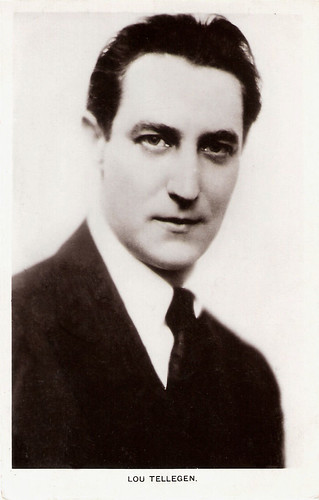
British postcard by Real Photograph in the Picturegoer series, London, no. 212.

Lou Tellegen
British postcard in the Picturegoer Series, no. 212a.

Lou Tellegen
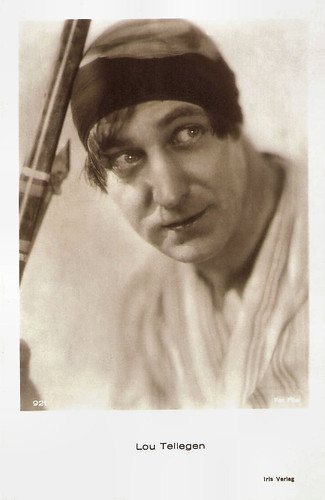
Austrian postcard by Iris Verlag, no. 921. Photo: Fox Film.

Lou Tellegen
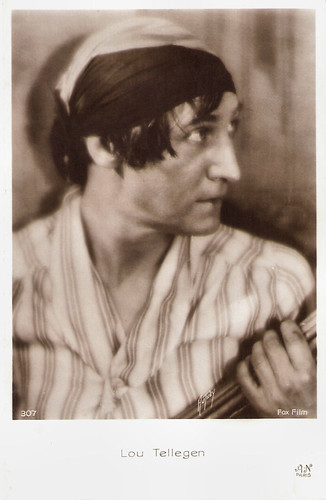
French postcard by A.N., Paris, no. 307. Photo: Max Munn Autrey / Fox Film.

A messy and very public divorce


In 1916, the opera diva turned film actress and the matinee idol married. They appeared in three films together: The World and Its Woman (Frank Lloyd, 1919), Flame of the Desert (Reginald Barker, 1919) and The Woman and the Puppet (Reginald Barker, 1920). Farrar's final film was the silent drama The Riddle: Woman (Edward José, 1920), in which her co-star was Montagu Love.

Lou Tellegen became an American citizen in 1918. He combined his work in the cinema with a successful stage career. Tellegen also worked as a producer and co-wrote two successful plays - 'Blind youth' (1917) with Willard Mack and 'The lust of gold' (1919) with Andor Garvay – which earned him a lot of money.

Tellegen was considered one of the best-looking actors of the silent screen, although our postcards don't confirm this. He was jealous about Farrar's successes and could not stand to be in her shadow. He started to drink and gamble, and numerous affairs followed. His marriage with Farrar became the source of considerable scandal. It ended in a messy and very public divorce in 1923.

Geraldine Farrar retired from opera in 1922 at the age of 40. Her final performance was as Leoncavallo's 'Zazà'. By this stage, her voice was in premature decline due to overwork. She quickly transitioned into concert recitals, and was signed (within several weeks of announcing her opera retirement) to an appearance at Hershey Park on Memorial Day 1922. She continued to make recordings and give recitals throughout the 1920s.

Lou Tellegen appeared in numerous silent films for Vitagraph and Fox Film, including The Redeeming Sin (J. Stuart Blackton, 1925) with Alla Nazimova, and Parisian Love (Louis J. Gasnier, 1925) with Clara Bow.

One of his memorable roles was as the corrupt Sheriff in John Ford's classic Western Three Bad Men (1926), wearing a white hat instead of the stereotypical bad guy black hat. He also directed a film starring Dolores del Rio, No Other Woman (Lou Tellegen, 1928), but it was not a success.

After his face was damaged in a hotel fire in 1929 and sound film had areived, Lou Tellegen’s fame faded. Among his rare sound film appearances were a supporting part in the crime film Enemies of the Law (Lawrence C. Windom, 1931) with Mary Nolan, and a bit part in Caravane (Erik Charell, 1934) starring Charles Boyer.

Employment was not forthcoming and debt-ridden, he went bankrupt. He was diagnosed with cancer, though this information was kept from him, and he became despondent. In 1934, Tellegen locked himself in the bathroom of a mansion of a female admirer in Los Angeles. He shaved and powdered his face, and while standing in front of a full-length mirror, he committed harakiri by stabbing himself seven times with a pair of golden scissors (which had his name engraved on them).

When asked to comment on Tellegen's death, Geraldine Farrar replied candidly: "Why should that interest me?" The Tellegen interlude, the prima donna claimed long ago, left only "a surface scar." Smit imagines that Farrar must have been devastated. The handsome Dutchman had been the love of her life. She never remarried and had no children. In 1967, Farrar died in Ridgefield, Connecticut of heart disease, aged 85.

Susan Smit beautifully imagines Tellegen's and Farrar's boundless ambition, their doubts, fears and their passionate love that was doomed to fail. But at the same time the novel is the story of an exciting time in which Europe loses its innocence in a horrible war; the women's movement is slowly gaining ground, and a mass medium sees the light of day that changed the world forever: the cinema.

Geraldine Farrar
German postcard by K.V.i.B., Dess, no. 1016.

Geraldine Farrar
German postcard by PH, no. 4116/1. Geraldine Farrar as Marguerite in Charles Gounod's opera 'Faust'.

Geraldine Farrar
German postcard by K.V.i.B. 12. Dess., no. 4017.

Geraldine Farrar
French postcard, sent by mail in 1907. Geraldine Farrar in the opera 'Mignon'.

Geraldine Farrar
French postcard. Publicity for Vins Désiles. Photo SIP, Boyer. G. Farrar de l'Opéra Impéraile de Berlin. Caption: J'ai plaisir à recommander l'excellent Vin Désiles (I enjoy recommending the excellent V.D.).

Sources: Book, Bob Bertina (Lou Tellegen. Een Hollander in Hollywood, VN Bijlage 1985 - Dutch), A.J.C.M. Gabriëls (Institute of Netherlands History), Andrea Suhm-Binder (Cantabile subito), Bob Hufford (Find A Grave), Wikipedia and IMDb.

07 July 2015

Lou Tellegen

Lou Tellegen (1883-1934) was considered one of the best-looking actors of the silent screen - first in France and later in the United States. He made three pictures with Sarah Bernhardt. Then the ‘Stage Adonis’ starred in a London production of Oscar Wilde’s The Picture of Dorian Gray. In Hollywood he married opera diva Geraldine Farrar and co-starred with her in three of her films. As the silent era ended, Tellegen's career was also over. He finished his tempestuous life by committing hara-kiri with a pair of golden scissors, as the legend goes.

Lou Tellegen
British postcard in the Picturegoer series, London, no. 212.

The Divine Sarah


Lou Tellegen (or Lou-Tellegen) was born as Isidor Louis Bernard Edmon van Dommelen in Sint-Oedenrode, The Netherlands, in 1883 (several sources mistakenly mention 1881). He was the illegitimate child of former army lieutenant Isidor Louis Bernard Edmon Tellegen and actress Anna Maria van Dommelen. His family moved a year later to Nijmegen and then to Amsterdam.

Lou made his stage debut in 1903 with the stage company Rotterdamsch Tooneel of Dieck van Eysden. He moved to Brussels and later to Paris, where he worked as a model for such artists as Lacroix, Constantin Meunier and Auguste Rodin, and as a prize-boxer. He studied at the Conservatoire Nationale de Musique et de Déclamation, and worked for the Théâtre de l'Odéon under André Antoine, the innovative founder of the Théâtre Libre. Tellegen became an eager and dedicated stage actor with Italy’s most famous actress at the time, Eleonora Duse.

Later he met dandy-actor Edouard de Max, who introduced him to Sarah Bernhardt. Eventually Lou co-starred in several roles with the Divine Sarah, and was also romantically involved with her. In 1910, he made his motion picture debut as Armand Duval alongside Bernhardt in La dame aux camellias/Camille (Louis Mercanton, 1911), a French silent film based on the play by Alexandre Dumas, fils.

In 1910, Tellegen and Bernhardt travelled to the United States to appear on stage in Jeanne d’Arc (Joan of Arc). The New York Times first published, and then retracted, the announcement of their impending marriage. She was 37 years his senior.

Back in France, they made their second film together, Les Amours de la reine Élisabeth/Queen Elizabeth (Henri Desfontaines, Louis Mercanton, 1912). The film was an adaptation of a play by Émile Moreau about episodes of the life of Elizabeth I, Queen of England (1533-1603), and focussed on her ill-fated love affair with Robert Devereux, Earl of Essex (Tellegen). It was an enormous success in the U.S., where it was distributed by a young Adolph Zukor.

The following year, Bernhardt and Tellegen appeared again together in Adrienne Lecouvreur/An Actress's Romance (Henri Desfontaines, Louis Mercanton, 1913). This film is considered a lost film. In the summer of 1913, Tellegen went to London where he produced, directed and starred in the Oscar Wilde play The Picture of Dorian Gray.

Edouard de Max
Edouard de Max. French postcard.

Sarah Bernhardt
Sarah Bernhardt. Postcard sent from Leipzig, 31 October 1905, to Laibach, Krain, Austria (now Ljubljana, Slovenia). The author wrote in German but using the Greek alphabet and signed Hugo Reizenbach. The adressee was Christl Kantz.

One of the Best-looking Actors on Screen


Invited back to the United States, Lou Tellegen worked in the theatre and soon became a matinee idol. One of the reviews read: 'French romance, hand-kissing romance, dashing romance, it lives again with Tellegen'. His leading role in the melodrama Maria Rosa was a spectacular success.

Samuel Goldwyn, at the time financial director of the Jesse L. Lasky Feature Play Company, saw Tellegen in 1915 in this play and offered him a contract for six films. His American film début was The Explorer (George Melford, 1915), followed by The Unknown (George Melford, 1915), both with Dorothy Davenport as his co-star.

Considered one of the best-looking actors on screen, Tellegen starred in numerous silent films opposite such stars as Sessue Hayakawa, in The Victoria Cross (Edward LeSaint, 1916), and Nell Shipman, in The Black Wolf (Frank Reicher, 1917).

In 1916, he married Geraldine Farrar, a well-known opera diva turned film actress, who was herself known to be the lover of Germany's Crown Prince Wilhelm of Germany. He appeared with Farrar in three films: The World and Its Woman (Frank Lloyd, 1919), Flame of the Desert (Reginald Barker, 1919) and The Woman and the Puppet (Reginald Barker, 1920). Their marriage did not last and they divorced in 1923.

Lou Tellegen had become an American citizen in 1918. He combined his work in the cinema with a successful stage career. Tellegen also worked as a producer and co-wrote two successful plays - Blind youth (1917) with Willard Mack, and The lust of gold (1919) with Andor Garvay – which earned him a lot of money.

For Vitagraph and Fox Film he appeared in numerous silent films including The Redeeming Sin (J. Stuart Blackton, 1925) with Alla Nazimova and Parisian Love (Louis J. Gasnier, 1925) with Clara Bow.

One of his memorable roles was as the corrupt Sheriff in John Ford's Western 3 Bad Men (1926) who wore a white hat instead of the stereotypical bad guy black hat. He directed a film starring Dolores del Rio, No Other Woman (Lou Tellegen, 1928), but it was not a success.

Lou Tellegen
Austrian postcard by Iris Verlag, no. 921. Photo: Fox Film.

Lou Tellegen
French postcard by A.N., Paris, no. 307. Photo: (Max Munn) Autrey / Fox Film.

Harakiri


After his face was damaged in a hotel fire in 1929 and sound film had arrived, Lou Tellegen’s fame faded. According to novelist Kathy Charles, Lou possessed “a high-pitched voice that could curl the hairs on your neck, Tellegen’s career was destroyed by the advent of dialogue in the cinema, and he instantly became a has-been.”

Among his rare sound film appearances were a supporting part in the crime film Enemies of the Law (Lawrence C. Windom, 1931) with Mary Nolan, and a bit part in Caravane (Erik Charell, 1934) starring Charles Boyer. Employment was not forthcoming and debt-ridden, he went bankrupt.

He was diagnosed with cancer, though this information was kept from him, and he became despondent. In 1934, Tellegen locked himself in the bathroom of a mansion of a female admirer, the rich widow Edna Cuhady, on North Vine Street in Los Angeles. He shaved and powdered his face, and while standing in front of a full-length mirror, he committed hara-kiri by stabbing himself seven times with a pair of golden scissors (which had his name engraved on them). Reportedly he was surrounded by newspaper clippings of his career, which he had always cut with the same golden scissors.

According to a 1934 article in Time Magazine, the many obituaries “told how at 15 he ran off with his father's mistress, how he specialized in love-making while he was successively a baker's assistant, a trapeze artist, a model for Auguste Rodin (Eternal Springtime, the original which is now in the Metropolitan Museum), how he first arrived in the U.S. as Sarah Bernhardt's leading man. The final Hollywood picture was of a broken, hollow-eyed matinee idol who kept having his face lifted.“

These obituaries were mostly taken from Tellegen's highly fictitious memoir, Women Have Been Kind (1931). Dorothy Parker called it "rubbish" in Vanity Fair, and suggested the title should have been Women Have Been Kind - of Dumb. Tellegen's wives were Countess Jeanne de Brouckère (1903-1905) - an artist whom he had met while he was an artist’s model in Paris and with whom he had a daughter, Diane; Geraldine Farrar (1916-1923); Isabelle Craven Dilworth - an actress with the stage name Nina Romano (1923-1928) with whom he had a son, Rex; and actress and former Ziegfield girl Eve Casanova (1930-1934).

When asked to comment on Tellegen's death, Geraldine Farrar replied candidly: "Why should that interest me?" The Tellegen interlude, the prima donna claimed long ago, left only "a surface scar." His wife Eve Casanova sent her regrets from New York but did not have the time to attend his funeral. All in all, only 37 family members and friends showed up for the funeral of a man that at one time had millions of fans worldwide.

Lou Tellegen was burned to ashes which, as a last theatrical gesture, he ordered sprinkled on the waves of the Pacific. Posthumously his last film was released, the drama Together We Live (Willard Mack, 1935). In 2011, David W. Menefee published The Rise and Fall of Lou Tellegen.


Short clip from from Les Amours de la reine Élisabeth/Queen Elizabeth (1912). Robert Devereux (Tellegen) is executed. Queen Elizabeth (Sarah Bernhardt) visits his corpse, and mourns for him. Source: swagner99 (YouTube).


Long clip from Parisian Love (Louis Gasnier, 1925) with Lou Tellegen and Clara Bow. Source: classicmoviegirl91 (YouTube).

Sources: Bob Bertina (Lou Tellegen. Een Hollander in Hollywood, VN Bijlage 1985 - Dutch), A.J.C.M. Gabriëls (Institute of Netherlands History), Erik Brouwer (De Volkskrant - Dutch), Kathy Charles (John Belushi is Dead), Allan Ellenberger (Hollywoodland), Time, Wikipedia and IMDb.

12 October 2024

Puccini and silent film

Le Giornate del Cinema Muto 2024 commemorates the centenary of Giacomo Puccini's death by screening the classic film version of La Bohème made by King Vidor in 1926, starring Lillian Gish and John Gilbert. Many silent films were based on the sources for Puccini’s operas. In the context of the 43rd edition of The Silent Film Festival of Pordenone, EFSP offers an overview based on 20 special postcards and a photo.

Giacomo Puccini
Italian postcard by B.F.F. Edit. (Casa Editrice Ballerini & Fratini, Firenze), no. 755. Giacomo Puccini (1858-1924) was an Italian opera composer, considered among the greatest, of the late 19th and early 20th centuries. He was a visionary and creator of the concepts that would govern cinema during the 20th century. His third opera, 'Manon Lescaut' (1893), was a success and brought him into contact with librettists Luigi Illica and Giuseppe Giacosa, who collaborated with him on his next three operas. The first of these, 'La bohème' (1896), is considered one of his best works and also one of the most romantic operas of all time. His next opera, 'Tosca' (1900), was Puccini's first foray into verismo, the naturalistic style in literature and opera. 'Madame Butterfly' (1904) was based on a play by David Belasco. This opera received a very hostile reception at its premiere. That criticism was largely orchestrated by rivals of Puccini. After several revisions, it became one of his most successful operas.

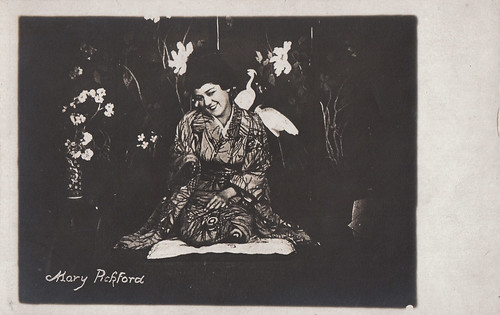
Mary Pickford in Madame Butterfly (1915)
Vintage postcard. Mary Pickford as the Japanese character Cho-Cho-San in Madame Butterfly (Sidney Olcott, 1915). Collection: Marlene Pilaete.

Leda Gys in La Bohème
Italian postcard by G.B. Falci, Milano, no. 300. Photo: Leda Gys as Mimì in La Bohème (Amleto Palermi, 1917).

Tosca (1918)
Spanish postcard by Amattler Marca Luna. Series 5, no. 18. Photo: Caesar Film. Francesca Bertini as Floria Tosca, Gustavo Serena as Mario Cavaradossi, and Alfredo De Antoni as Baron Scarpia in the Italian silent film Tosca (Alfredo De Antoni, 1918). The execution of Cavaradossi on the roof of the Castel Sant' Angelo, with St Peter's cupola in the distance. Tosca discovers Scarpia's betrayal. She has just stabbed Scarpia to death. When Scarpia's men try to arrest her, she jumps off the roof with the words: "O Scarpia, Avanti a Dio!"

Carnevalesca
Spanish postcard by Amattler Marca Luna chocolate, series 7, no. 18. Lyda Borelli in Carnevalesca (Amleto Palermi 1918), after Lucio d'Ambra. Photography was by Giovanni Grimaldi. Maria Teresa discovers she has killed the man she loved while he was innocent. Just as with the dead Scarpia in Puccini's opera 'Tosca' and the preceding play by Sardou performed by Sarah Bernhardt, candles are placed next to the dead person.

Maria Jacobini in La Boheme (1923)
Spanish collector card in the Escenas selectas de cinematografia series. Maria Jacobini in La Bohème/ Boheme - Künstlerliebe (Gennaro Righelli, 1923), based on the novel by Henri Murger, which later was turned into an opera by Giacomo Puccini.

Renee Adoree in La Boheme (1926)
Italian postcard by Ballerini & Fratini, Firenze, no. 282. Photo: Metro-Goldwyn, Rome. Renée Adorée in La Boheme (King Vidor, 1926). Collection: Marlene Pilaete.

Puccini in the Italian silent film


If one consults the Internet Movie Database, it seems that in the silent era, only three Brazilian shorts of 1908-1909 were based on Giacomo Puccini’s operas. Many silent films were based on the sources for Puccini’s operas such as Victorien Sardou’s play 'Tosca' (1887). Another example (1887) is 'Scènes de la vie de bohème' (1849) by Henry Murger. And don't forget 'L’Histoire du chevalier des Grieux et de Manon Lescaut' (1731) by Abbé Prévost.

Puccini's 'Madame Butterfly' was based on a short story (1898) by John Luther Long, which was turned into a stage play (1900) by David Belasco, which in return inspired Puccini for his opera. Thus, to avoid any copyright problems, and being unable to recreate the voices and orchestras from the opera, filmmakers relied on the literary and theatrical sources for the operas, using their plots, but staging them with different means.

It may not come as a surprise that Italy produced several films based, directly or indirectly on Puccini’s operas, such as the 1918 version of Tosca with Francesca Bertini, which would be one of Bertini’s most popular films worldwide. Her regular co-star of the 1910s, Gustavo Serena, played Cavaradossi, while Alfredo De Antoni directed.

Exceptionally, Puccini’s music was played at the premiere of the film, with the consent of Giacomo Puccini’s musical agent Ricordi. Unfortunately, only a fragment of the film remains, but we do have a large card series. In the documentary, L’ultima diva/The Last Diva (1982) by Gianfranco Mingozzi, Bertini, in her nineties, re-enacts her dying scene at the end of Tosca, when her character commits suicide by jumping from the Castel Sant’Angelo.

Yet, this film version of 'Tosca' was preceded by a short version by André Calmettes, filmed in 1908 and starring Sarah Bernhardt, for whom Sardou had written the stage play. Also, in 1911 Dutch film director Theo Frenkel filmed in Great Britain a version of 'Tosca', in which the actress Lillian Russell debuted on screen. A reference to the death of Scarpia in 'Tosca' was made in Amleto Palermi’s film Carnevalesca (1918), starring Lyda Borelli as Queen Maria Teresa, who has unjustly stabbed her newlywed husband. Just as with the death of Scarpia in Puccini's opera 'Tosca' and the preceding play by Sardou as performed by Sarah Bernhardt, candles are placed next to the dead person.

La Tosca
French postcard by A & S (Saint-Just), Paris, no. 903/8. Caption: Tosca has just killed Baron Scarpia. From a series of staging moments in the play by Sardou and the opera by Puccini. In the 1900s, publisher A.S./ Saint-Just made several staged, coloured postcard series based on operas and operettas such as 'Faust', 'Manon Lescaut', 'Carmen', 'Cavalleria rusticana', 'Die schöne Galathée' (presented as 'Galathée et Pygmalion'), 'La fille du régiment', 'Pippo et Bettina', 'La fille de Madame Angot' and 'Le passant'. There were also series based on books such as 'Paul et Virginie', and plays such as 'Cyrano de Bergerac' and 'Madame Sans-Gène'.

Antonio Cortis
Italian postcard in the series La Voce del Padrone (HMV). Portrait: Nanni. Tenor Antonio Cortis as the painter Mario Cavaradossi in the opera 'Tosca' by Puccini. Hear him sing the famous aria' E lucevan le stelle' from Tosca here (recording of 1929) on YouTube.

Geraldine Farrar in Madam Butterfly
German postcard by GG Cie, no. 5050. Geraldine Farrar as Madame Butterfly.

Geraldine Farrar in Tosca
German postcard by Verlag Herm. Leiser, Berlin, no. 6530. Photo: H. Manuel. Geraldine Farrar in the opera 'Tosca'.

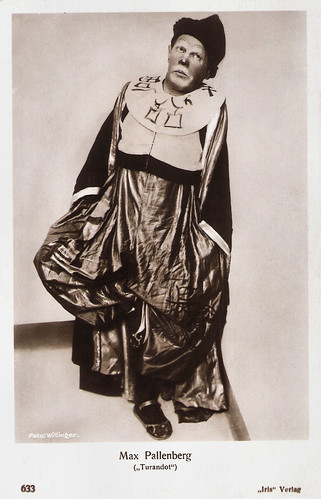
Max Pallenberg in Turandot
Austrian postcard by Iris Verlag, no. 633. Photo: Laszlo Willinger. Under the direction of Max Reinhardt, Max Pallenberg played Traffaldino in 'Turandot' (1926) by Giacomo Puccini at the Salzburger Festspiele.

Colleen Moore as Madame Butterfly.
French postcard by Cinémagazine-Edition, no. 572. Photo: Freulich / First National. Colleen Moore as Madame Butterfly. The photo was specially posed for Motion Picture magazine in 1928.

Puccini in Hollywood


Hollywood also discovered Puccini as a source for silent films. In 1915, Mary Pickford starred opposite future film director Marshall Neilan as Lt. Pinkerton in Famous Players’ version of 'Madame Butterfly', directed by Sidney Olcott. The film was shot in a Chinese garden in Plainfield, New Jersey.

In Germany, Fritz Lang filmed a variation on the 'Madame Butterfly' plot as Harakiri (1919). While the film’s story has a preceding plot, halfway the film’s plot becomes the familiar one about a young Japanese woman abandoned by her lover, a European navy officer. She gives birth to their son in his absence and faithfully awaits his return. When he returns after four years, he is accompanied by his European wife. Lil Dagover played the lead.

Three major adaptations of 'La Bohème' were filmed in the silent era, in Italy, in Germany, and in the United States. Firstly, the Italian version was filmed in 1917 by Amleto Palermi, starring Leda Gys as Mimí and Luigi Serventi as Rodolphe.

In Germany, Italian director Gennaro Righelli, who had fled Italy after its film crisis in the early 1920s, directed Bohème a.k.a. Künstlerliebe (1923), starring Righelli’s lover Maria Jacobini as Mimí and Walter Janssen as Rodolphe. Serventi also joined, but now as Count Paul.

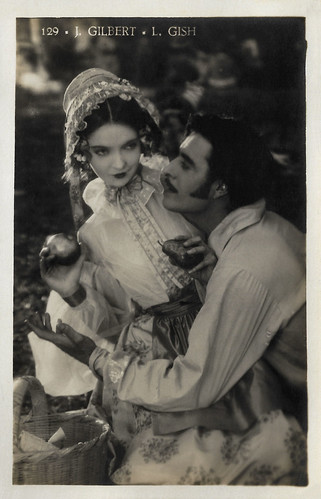
The most famous adaptation was the American film La Bohème (1926) by King Vidor, who gave the female lead to Lillian Gish and selected John Gilbert as Rodolphe. According to IMDb, John Gilbert was so infatuated with Gish that he would mess up his love scenes, so he could kiss her over and again. A review on IMDb indicates the strong emotional performance by Gish but also Vidor’s focus on her face as a strong asset of the film.

Leda Gys in La Bohème
Italian postcard by G.B. Falci, Milano, no. 307. Leda Gys as Mimì in La Bohème (Amleto Palermi, 1917).

Francesca Bertini in Tosca
Italian postcard by Ed. Vettori, Bologna. Francesca Bertini als Tosca and Alfredo De Antoni as baron Scarpia in Tosca (Alfredo De Antoni, 1918).

Gustavo Serena
Spanish postcard by Gurgui, no. 11. Gustavo Serena as Mario Cavaradossi in Tosca (Alfredo De Antoni, 1918).

Tosca (1918)
Spanish postcard by Amattler Marca Luna. Series 5, no. 1. Photo: Caesar Film. Francesca Bertini as Floria Tosca in Tosca (Alfredo De Antoni, 1918). Francesca Bertini as Tosca, in a citation of the famous portrait of Madame Récamier by J.L. David.

Lilian Gish and John Gilbert in La Bohème (1926)
Italian postcard by Fotocelere, no. 129. Photo: Metro-Goldwyn-Mayer (MGM). Lillian Gish and John Gilbert in La Bohème (King Vidor, 1926). After 13 years with D.W. Griffith, Lillian Gish moved to MGM where her first picture was La Bohème (1926).

Lillian Gish in La Bohème (1926)
Italian postcard by Casa Editrice Ballerini & Fratini, Firenze (B.F.F.), no. 199. Photo: Metro-Goldwyn, Roma (MGM). Lillian Gish in La Bohème (King Vidor, 1926).

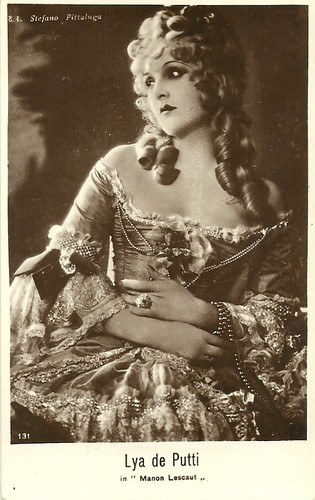
Lya de Putti and Vladimir Gajdarov in Manon Lescaut (1926)
Italian postcard by G.B. Falci, Milano, no. 129. Photo: A. Stefano Pittaluga. Lya de Putti and Vladimir Gajdarov in Manon Lescaut (Arthur Robison, 1926), based on the oft-filmed novel by Abbe Prevost. It was produced and distributed by German film company Universum Film AG better known as Ufa. A young actress named Marlene Dietrich had a supporting role in this production and showed her later famous legs.

Lya de Putti
Italian postcard by G.B. Falci, Milano, no. 131. Photo: A. Stefano Pittaluga. Lya de Putti in Manon Lescaut (Arthur Robison, 1926).

Torre del Lago, statue of Giacomo Puccini by Paul Troubetzkoy
Torre del Lago, statue of Giacomo Puccini by Paul Troubetzkoy. Photo by Ivo Blom. Troubetzkoy's original statue (1925), quite small actually, can be viewed at the Museo Villa Puccini in Torre del Lago. From 1891, Puccini often spent time at Torre del Lago near Viareggio, where he built his Villa in 1900 and lived until 1921. An annual Puccini festival is now held at Torre del Lago, while his villa has become a museum.

Sources: Le Giornate del Cinema Muto (Italian), Jbill-74877 (IMDb), Wikipedia and IMDb.