Cinefest is over, but today we have an encore. A kind of sequel to last week's post on animator Marten Toonder, a post on his one-time collaborator Joop Geesink (1913 -1984). This Dutch film producer and puppeteer was internationally known for his 'Dollywood' shorts, stop motion animation films with puppets. In the Netherlands, Geesink remains most fondly remembered for his creation Loeki de Leeuw (Loeki the Lion), which brightened up the commercials on Dutch television from 1972 to 2004.
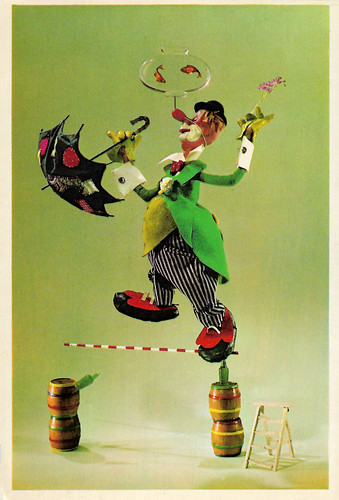
Dutch postcard by GRAVO. Image: Joop Geesink.

French postcard by D. Caplan Editeur, St. Nicolas d'Aliermont, no. 3. Image: Joop Geesink / Dollywood. Loeki the Lion and his friend Piep the Mouse.

Dutch postcard by Gebr. Spanjersberg, Rotterdam / Antwerp. Image: Joop Geesink / Dollywood.
Joop (Johan Louis) Geesink was born in The Hague, The Netherlands, in 1913. Geesink started his career painting billboards for cinemas. Then he worked as a set designer for Dutch theatre revues.
In the mid-1930s Geesink made illustrations and the comic 'Prik en Prak' (Prik and Prak) for the magazine Doe Mee. He made the drawings for the story 'De Reuzen Belfloor and Bonnevu in the land of King Kas Koes Kielewan' (The Giants Belfloor and Bonnevu in the land of King Kas Koes Kielewan) on a text by Dutch author A.D. Hildebrand, which was published in book form in 1941.
He also created a series of postcards with illustrations of militaries, which was published by EMNA during the time of the mobilisation (1939-1940). Geesink became interested in film - especially animation film - and in 1942, he started making films together with his brother and business partner Wim Geesink.
A merger with Marten Toonder, known for the comics of Tom Poes (Tom Puss) and Olivier B. Bommel (Oliver B. Bumble), resulted in the foundation of Toonder-Geesink Studios. Toonder was mainly concerned with cartoons and Geesink was more into puppet films. In this way, he could recreate the atmosphere of the theatre in miniature and let it move.
The collaboration lasted only one year: from March 1942 to March 1943. At Geesink's request, the Geesink-Toonder studio was disbanded in time, before major quarrels would arise. Toonder then founded Toonder Studios and the Geesink brothers started the Dollywood Studios - a combination of doll and Hollywood. This firm focused on documentaries, advertising films, and instruction films.
In 1944 Geesink designed two humoristic postcards at the occasion of the liberation of Belgium, and Semper in Equo later published 10 postcards with the title: 'Weet u nog wel?' (Do you remember?) In 1949, when Toonder ran into financial difficulties, a large group of employees went to Joop Geesink's Dollywood Studios. One of them was Han van Gelder, who worked on special effects until 1951. Han van Gelder had the exclamation of 'asjemenou', which would later be widely known by Loeki de Leeuw.
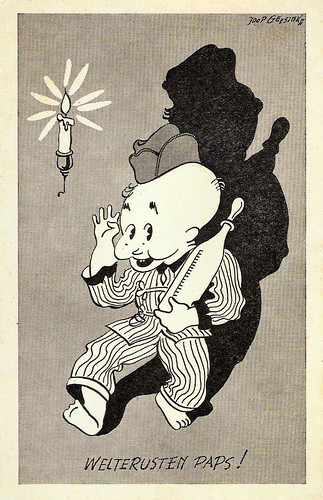
Dutch postcard by EMNA in the Militairen (militaries) series, no. 2. Image: Joop Geesink. Caption: Good night Dad!

Dutch postcard by GRAVO. Image: Joop Geesink.
In the 1950s the economy picked up and the number of orders increased. Joop Geesink turned out to be able to bring in customers in a very handy and convincing way. He usually had a basic idea that he developed further, after which he looked for a customer.
Philips became one of his most important customers and also ordered the making of several longer animation films (of about 10 minutes): Kermesse fantastique (1951), Light and Mankind (1954), Het verhaal met de baard/The Story with the Beard (1958), Piccolo, Saxo and Company (1960) and Philips Cavalcade - 75 years of Music (1966).
Other important (inter) national customers include the Nederlands Zuivelbureau (Dutch Dairy Company), Campari, Ballantine, Knorr, Peter Stuyvesant, North State, Coca-Cola, and Heineken.
In 1955 Geesink expanded the studio with Starfilm, under which name all live-action advertising assignments were produced. Geesink also produced more personal projects, such as the feature film Het wonderlijke Leven van Willem Parel/The wonderful life of Willem Parel (Gerard Rutten, 1955) with Dutch comedian Wim Sonneveld in the lead. Wim Sonneveld had created the character of Willem Parel the organ player for Dutch Radio. Each Saturday night thousands of people listened to ten minutes of Willem Parel. Sonneveld got fed up with this character and decided to end it with this picture. It got very bad reviews but audiences liked it.
Geesink also opened agencies in two major sales markets of his company: Germany and Italy. Sixty to seventy percent of the productions are for the foreign market. In the United States, it was called "the Geesink technique", which referred to the very well-executed art direction and professional animation technique.

Dutch postcard by GRAVO. Image: Joop Geesink.

Dutch postcard by GRAVO. Image: Joop Geesink.

Dutch postcard by GRAVO. Image: Joop Geesink.
Joop Geesink presented a new form of animation in the film The Travelling Tune (1962), commissioned by Philips: the paper doll technique with animated figures made of paper.
An important factor in the success of the Geesink studio was the rise of television advertising in the United States, Germany, Great Britain, and other countries. Geesink specialised in telling a story in a short time of 20 to 60 seconds and he knew how to be ahead of the competition. Sales figures and marketing surveys demonstrated the commercial success of Geesink advertising films.
In 1966 he invented Rick de Kikker/Rick the Frog, a puppet TV series for toddlers. It was initially intended that Rick the Frog would appear daily on television in five-minute episodes. Rick de Frog eventually was broadcasted by the TROS (Television Radio Broadcasting Foundation) but not every day. 26 episodes were made and the program was a major crowd puller and very popular with preschoolers. It appeared on Dutch Television from October 1967 to December 1968.
Geesink never succeeded in becoming a major producer of television advertising in the Netherlands. When advertising was introduced on television in 1967, Geesink did produce 12 of the 38 spots, but in the end, he was unable to compete with the smaller production companies that had much less fixed costs.
In addition, the studio ran into serious financial problems in the late 1960s due to the failure of the Holland Promenade project, a kind of educational amusement park. The result of this financial setback is that Geesink has to part with his company.

Dutch postcard by Vita Nova, Schiedam. Image: Joop Geesink. Publicity still for the TV series Rick de Kikker/Rick the Frog (1967-1968). The postcard was sent by mail in 1968.

French postcard by D. Caplan Editeur, St. Nicolas d'Aliermont, no. 1. Image: Joop Geesink / Dollywood.

Dutch postcard by Gebr. Spanjersberg, Rotterdam / Antwerp. Image: Joop Geesink / Dollywood.
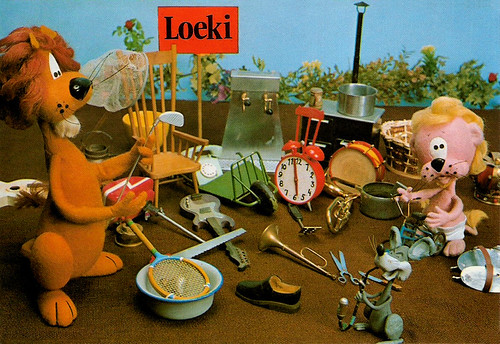
Dutch postcard by Gebr. Spanjersberg, Rotterdam / Antwerp. Image: Joop Geesink / Dollywood.
The studio, with the new name Joop Geesink Filmproduktie, became part of the Toonder Studios in 1972, which were located in Nederhorst den Berg. There Joop Geesink Filmproduktie continued with some projects that were started under the leadership of Joop Geesink.
His signature character was Loeki de Leeuw (Loeki the Lion, 1972-2004). Loeki, a stop-motion animated lion, came to national prominence when advertising was first allowed on Dutch television in 1972. Regulatory requirements had been drawn up in order that the public could make a clear distinction between the programmes and the adverts, and the solution chosen was a short break bumper which would signal the beginning and end of the advertisement breaks.
These bumpers comprised humorous animations of Loeki and his friends, including Piep de Muis (Piep the Mouse), and were such a success with the public that Loeki soon started appearing in between individual commercials. Studio Geesink estimates that over 8000 individual films were made, several of which survive on home-made VHS recordings which have been uploaded to YouTube. Loeki appeared in France as Loeki le Lion, in England (in the Westward TV region), Austria, Italy, Japan, and in the United States.
By 1977 Geesink launched 'Dusty', a kangaroo with a broom for his tale. The character originated in a series of animated TV shorts, produced by the Toonder Studios, aiming to create awareness for a clean environment. Dusty' was sold to several foreign TV networks, including RAI Due in Italy, where it became a tremendous success.
Another creation of Geesink was the Carnival Festival attraction in the Dutch amusement park De Efteling, in which dolls were again central. On 1 February 1984 Geesink gave a press conference about the Carnival Festival. The deathly ill Geesink managed to make a test drive before the opening and be present at the informal opening at the start of the season.
A month before the official opening to the public, on 13 May 1984, Joop Geesink passed away in Amsterdam. His daughter Louise Geesink took over Geesink's Dollywood Studios when her father died. Joop Geesink's name lives on in the Joop Geesink Prize, an annual award distributed during the Holland Animation Filmfestival.

Dutch postcard by Gebr. Spanjersberg, Capelle ad IJssel / Brasschaat. Image: Joop Geesink's Dollywood, 1988. Caption: Merry Christmas and Happy New Year. Sent by mail in 1989.
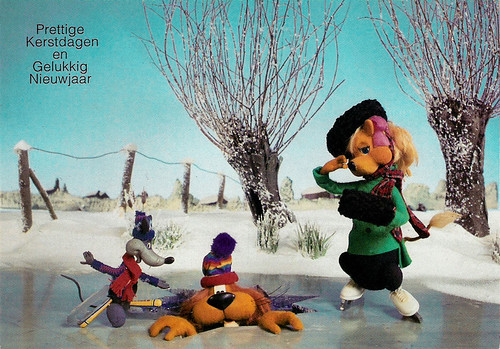
Dutch postcard by Gebr. Spanjersberg, Capelle ad IJssel / Brasschaat, no. 770022. Image: Joop Geesink's Dollywood, 1988. Caption: Merry Christmas and Happy New Year.

Dutch postcard by Gebr. Spanjersberg, Capelle ad IJssel / Brasschaat. Image: Joop Geesink's Dollywood, 1988. Caption: Merry Christmas and Happy New Year. Sent by mail in 1990.
Sources: Bas Schuddeboom & Kjell Knudde (Lambiek Comiclopedia), RKD, Geesink Studio (Dutch), Wikipedia (Dutch), and IMDb.
Dutch postcard by GRAVO. Image: Joop Geesink.
French postcard by D. Caplan Editeur, St. Nicolas d'Aliermont, no. 3. Image: Joop Geesink / Dollywood. Loeki the Lion and his friend Piep the Mouse.
Dutch postcard by Gebr. Spanjersberg, Rotterdam / Antwerp. Image: Joop Geesink / Dollywood.
A combination of doll and Hollywood
Joop (Johan Louis) Geesink was born in The Hague, The Netherlands, in 1913. Geesink started his career painting billboards for cinemas. Then he worked as a set designer for Dutch theatre revues.
In the mid-1930s Geesink made illustrations and the comic 'Prik en Prak' (Prik and Prak) for the magazine Doe Mee. He made the drawings for the story 'De Reuzen Belfloor and Bonnevu in the land of King Kas Koes Kielewan' (The Giants Belfloor and Bonnevu in the land of King Kas Koes Kielewan) on a text by Dutch author A.D. Hildebrand, which was published in book form in 1941.
He also created a series of postcards with illustrations of militaries, which was published by EMNA during the time of the mobilisation (1939-1940). Geesink became interested in film - especially animation film - and in 1942, he started making films together with his brother and business partner Wim Geesink.
A merger with Marten Toonder, known for the comics of Tom Poes (Tom Puss) and Olivier B. Bommel (Oliver B. Bumble), resulted in the foundation of Toonder-Geesink Studios. Toonder was mainly concerned with cartoons and Geesink was more into puppet films. In this way, he could recreate the atmosphere of the theatre in miniature and let it move.
The collaboration lasted only one year: from March 1942 to March 1943. At Geesink's request, the Geesink-Toonder studio was disbanded in time, before major quarrels would arise. Toonder then founded Toonder Studios and the Geesink brothers started the Dollywood Studios - a combination of doll and Hollywood. This firm focused on documentaries, advertising films, and instruction films.
In 1944 Geesink designed two humoristic postcards at the occasion of the liberation of Belgium, and Semper in Equo later published 10 postcards with the title: 'Weet u nog wel?' (Do you remember?) In 1949, when Toonder ran into financial difficulties, a large group of employees went to Joop Geesink's Dollywood Studios. One of them was Han van Gelder, who worked on special effects until 1951. Han van Gelder had the exclamation of 'asjemenou', which would later be widely known by Loeki de Leeuw.
Dutch postcard by EMNA in the Militairen (militaries) series, no. 2. Image: Joop Geesink. Caption: Good night Dad!
Dutch postcard by GRAVO. Image: Joop Geesink.
Bringing in customers in a very handy and convincing way
In the 1950s the economy picked up and the number of orders increased. Joop Geesink turned out to be able to bring in customers in a very handy and convincing way. He usually had a basic idea that he developed further, after which he looked for a customer.
Philips became one of his most important customers and also ordered the making of several longer animation films (of about 10 minutes): Kermesse fantastique (1951), Light and Mankind (1954), Het verhaal met de baard/The Story with the Beard (1958), Piccolo, Saxo and Company (1960) and Philips Cavalcade - 75 years of Music (1966).
Other important (inter) national customers include the Nederlands Zuivelbureau (Dutch Dairy Company), Campari, Ballantine, Knorr, Peter Stuyvesant, North State, Coca-Cola, and Heineken.
In 1955 Geesink expanded the studio with Starfilm, under which name all live-action advertising assignments were produced. Geesink also produced more personal projects, such as the feature film Het wonderlijke Leven van Willem Parel/The wonderful life of Willem Parel (Gerard Rutten, 1955) with Dutch comedian Wim Sonneveld in the lead. Wim Sonneveld had created the character of Willem Parel the organ player for Dutch Radio. Each Saturday night thousands of people listened to ten minutes of Willem Parel. Sonneveld got fed up with this character and decided to end it with this picture. It got very bad reviews but audiences liked it.
Geesink also opened agencies in two major sales markets of his company: Germany and Italy. Sixty to seventy percent of the productions are for the foreign market. In the United States, it was called "the Geesink technique", which referred to the very well-executed art direction and professional animation technique.
Dutch postcard by GRAVO. Image: Joop Geesink.
Dutch postcard by GRAVO. Image: Joop Geesink.
Dutch postcard by GRAVO. Image: Joop Geesink.
A new form of animation
Joop Geesink presented a new form of animation in the film The Travelling Tune (1962), commissioned by Philips: the paper doll technique with animated figures made of paper.
An important factor in the success of the Geesink studio was the rise of television advertising in the United States, Germany, Great Britain, and other countries. Geesink specialised in telling a story in a short time of 20 to 60 seconds and he knew how to be ahead of the competition. Sales figures and marketing surveys demonstrated the commercial success of Geesink advertising films.
In 1966 he invented Rick de Kikker/Rick the Frog, a puppet TV series for toddlers. It was initially intended that Rick the Frog would appear daily on television in five-minute episodes. Rick de Frog eventually was broadcasted by the TROS (Television Radio Broadcasting Foundation) but not every day. 26 episodes were made and the program was a major crowd puller and very popular with preschoolers. It appeared on Dutch Television from October 1967 to December 1968.
Geesink never succeeded in becoming a major producer of television advertising in the Netherlands. When advertising was introduced on television in 1967, Geesink did produce 12 of the 38 spots, but in the end, he was unable to compete with the smaller production companies that had much less fixed costs.
In addition, the studio ran into serious financial problems in the late 1960s due to the failure of the Holland Promenade project, a kind of educational amusement park. The result of this financial setback is that Geesink has to part with his company.
Dutch postcard by Vita Nova, Schiedam. Image: Joop Geesink. Publicity still for the TV series Rick de Kikker/Rick the Frog (1967-1968). The postcard was sent by mail in 1968.
French postcard by D. Caplan Editeur, St. Nicolas d'Aliermont, no. 1. Image: Joop Geesink / Dollywood.
Dutch postcard by Gebr. Spanjersberg, Rotterdam / Antwerp. Image: Joop Geesink / Dollywood.
Dutch postcard by Gebr. Spanjersberg, Rotterdam / Antwerp. Image: Joop Geesink / Dollywood.
A stop-motion animated lion
The studio, with the new name Joop Geesink Filmproduktie, became part of the Toonder Studios in 1972, which were located in Nederhorst den Berg. There Joop Geesink Filmproduktie continued with some projects that were started under the leadership of Joop Geesink.
His signature character was Loeki de Leeuw (Loeki the Lion, 1972-2004). Loeki, a stop-motion animated lion, came to national prominence when advertising was first allowed on Dutch television in 1972. Regulatory requirements had been drawn up in order that the public could make a clear distinction between the programmes and the adverts, and the solution chosen was a short break bumper which would signal the beginning and end of the advertisement breaks.
These bumpers comprised humorous animations of Loeki and his friends, including Piep de Muis (Piep the Mouse), and were such a success with the public that Loeki soon started appearing in between individual commercials. Studio Geesink estimates that over 8000 individual films were made, several of which survive on home-made VHS recordings which have been uploaded to YouTube. Loeki appeared in France as Loeki le Lion, in England (in the Westward TV region), Austria, Italy, Japan, and in the United States.
By 1977 Geesink launched 'Dusty', a kangaroo with a broom for his tale. The character originated in a series of animated TV shorts, produced by the Toonder Studios, aiming to create awareness for a clean environment. Dusty' was sold to several foreign TV networks, including RAI Due in Italy, where it became a tremendous success.
Another creation of Geesink was the Carnival Festival attraction in the Dutch amusement park De Efteling, in which dolls were again central. On 1 February 1984 Geesink gave a press conference about the Carnival Festival. The deathly ill Geesink managed to make a test drive before the opening and be present at the informal opening at the start of the season.
A month before the official opening to the public, on 13 May 1984, Joop Geesink passed away in Amsterdam. His daughter Louise Geesink took over Geesink's Dollywood Studios when her father died. Joop Geesink's name lives on in the Joop Geesink Prize, an annual award distributed during the Holland Animation Filmfestival.
Dutch postcard by Gebr. Spanjersberg, Capelle ad IJssel / Brasschaat. Image: Joop Geesink's Dollywood, 1988. Caption: Merry Christmas and Happy New Year. Sent by mail in 1989.
Dutch postcard by Gebr. Spanjersberg, Capelle ad IJssel / Brasschaat, no. 770022. Image: Joop Geesink's Dollywood, 1988. Caption: Merry Christmas and Happy New Year.
Dutch postcard by Gebr. Spanjersberg, Capelle ad IJssel / Brasschaat. Image: Joop Geesink's Dollywood, 1988. Caption: Merry Christmas and Happy New Year. Sent by mail in 1990.
Sources: Bas Schuddeboom & Kjell Knudde (Lambiek Comiclopedia), RKD, Geesink Studio (Dutch), Wikipedia (Dutch), and IMDb.