31 August 2014

Chaplin (1992)

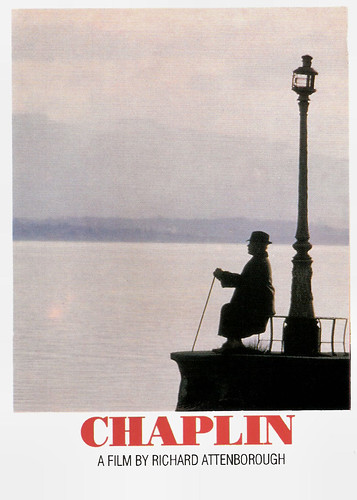
Last Sunday, 24 August 2014, Richard Attenborough (1923-2014) passed away at the age of 90. In honour of this great English actor, film director and producer, this film special is on his film Chaplin (Richard Attenborough, 1992), which featured Robert Downey Jr. as Charles Spencer Chaplin. All the postcards are from a series of French postcards to promote the film, published by Editions Mercuri.

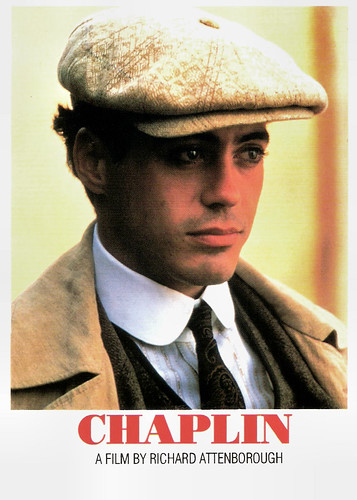
Chaplin (1992)
French postcard by Editions Mercuri, no. 813. Photo: Tri-Star Pictures. Publicity still for Chaplin (Richard Attenborough, 1992).
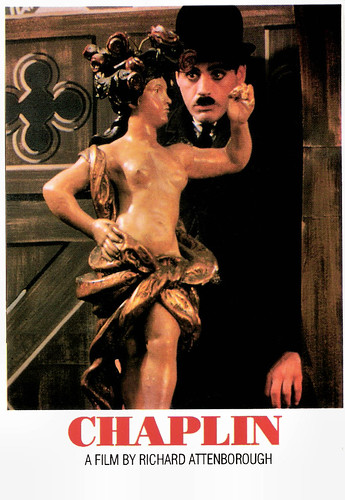
Chaplin (1992)
French postcard by Editions Mercuri, no. 814. Photo: Tri-Star Pictures. Publicity still for Chaplin (Richard Attenborough, 1992).
Chaplin (1992)
French postcard by Editions Mercuri, no. 815. Photo: Tri-Star Pictures. Publicity still for Chaplin (Richard Attenborough, 1992).

Haunted by a sense of loss


Chaplin (Richard Attenborough, 1992) is the biography of British comedian Charlie Chaplin, filmmaker extraordinaire.

It was produced and directed by Richard Attenborough and stars Robert Downey, Jr., Paul Rhys as Charlie's brother Sydney Chaplin, John Thaw as the British music-hall impresario Fred Karno, Marisa Tomei as film star Mabel Normand, and Penelope Ann Miller as Chaplin's frequent co-star Edna Purviance.

It also features Chaplin's real-life daughter, Geraldine Chaplin in the role of her own paternal grandmother, the mentally ill Hannah Chaplin.

The film was adapted by William Boyd, Bryan Forbes and William Goldman from the books My Autobiography by Chaplin and Chaplin: His Life and Art by film critic David Robinson.

The film is structured around lengthy flashbacks as the elderly Charlie Chaplin, now living in Switzerland, recollects moments from his life during a conversation with the editor of his autobiography (played by Anthony Hopkins).

Chaplin's recollections begin with his childhood of extreme poverty, from which he escapes by immersing himself in the world of the London music halls, after which he relocates to the United States.

While his screen characters were extremely hilarious, Chaplin shows that the man behind 'The Little Tramp' was constantly haunted by a sense of loss.

Highlighted works such as The Gold Rush (1925) and The Great Dictator (1940) illustrate significant turning points in Chaplin's prolific filmography.

There are references to his many romantic episodes, his professional collaboration with early Hollywood film producer Mack Sennett (Dan Aykroyd) and friendship with Douglas Fairbanks (Kevin Kline), and to J. Edgar Hoover (Kevin Dunn) whose US Federal Bureau of Investigation accused Chaplin of communist sympathies and forced him to leave the USA.

The film ends with Chaplin returning to the United States to accept an Honorary Award at the 1972 Academy Awards ceremony.

Richard Attenborough's director's cut was 147 minutes, 12 minutes longer than the version shown in cinemas. Attenborough later said that the cuts damaged the film.

Michael DeZeburia at IMDb: "Robert Downey Jr., first of all, portrays Chaplin with amazing accuracy. Some parts of this performance are particularly memorable, such as his invention of the famous tramp's walk just after having feverishly picked out the outfit, the astonishingly accurate depiction of Charlie as an old man, and of course, the many parts of the film that involve parts of his life where he was working on his own films."

Lisa Kropiewnicki at AllMovie: "The film is a thoughtful mixture of melancholy and humor, juxtaposing Chaplin's private loneliness and loss with his professional comedic talents and fortitude. Spanning a period of nearly 80 years in the actor's life, the film has been criticized for trying to cover too much narrative ground, but given the enormity of Chaplin's contribution to his art and the personal obstacles he overcame, this is an enjoyable, emotional, and authentic film."
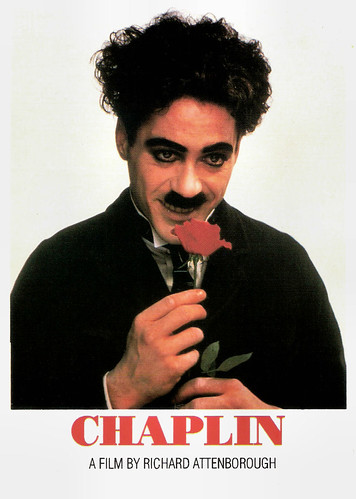
Chaplin (1992)
French postcard by Editions Mercuri, no. 816. Photo: Tri-Star Pictures. Publicity still for Chaplin (Richard Attenborough, 1992).
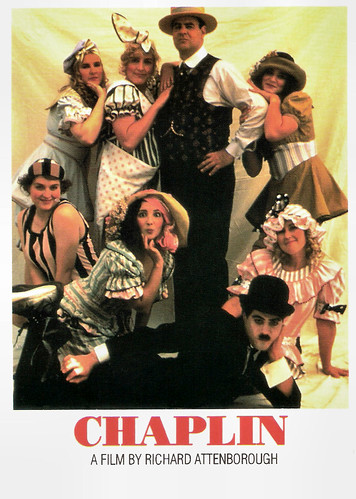
Chaplin (1992)
French postcard by Editions Mercuri, no. 817. Photo: Tri-Star Pictures. Publicity still for Chaplin (Richard Attenborough, 1992) with Dan Aykroyd as Mack Sennett and Robert Downey Jr. as Charlie Chaplin, between Sennett's Bathing Beauties.
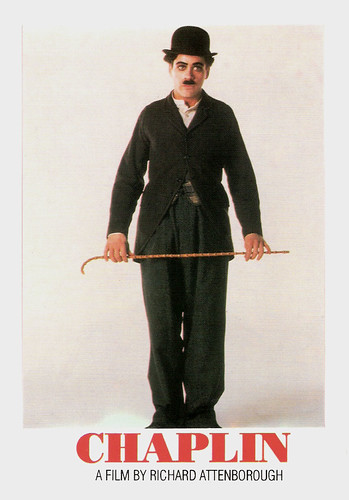
Chaplin (1992)
French postcard by Editions Mercuri, no. 819. Photo: Tri-Star Pictures. Publicity still for Chaplin (Richard Attenborough, 1992).

Sources: Lisa Kropiewnicki (AllMovie), Wikipedia and IMDb.

29 August 2014

Danielle Godet

Beautiful and distinguished Danielle Godet (1927-2009) had everything for a great career in the cinema, but she lacked the right film parts to live up to her many capacities. In secondary roles the charming French actress continued to work on stage, television and in 45 films.

Danielle Godet
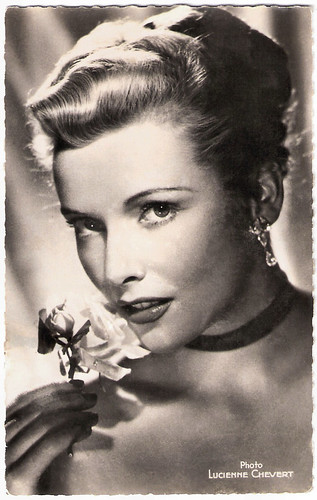
French postcard by Editions du Globe, Paris, no. 345. Photo: Lucienne Chevert.

The Idol


Danielle Gabrielle Rose Godet was born in Paris in 1927. She was the daughter of an industrialist and a stay-at-home mother, passionate about piano and classical music. Danielle inherited her artistic flair from her mother. The little girl studied piano and dance, going as far as to win first prize at the Léopold Belland dance contest. But it was the call of the cinema she was actually going to heed.

She made her film debut by chance, as the small village in which Danielle and her parents spent their summer holidays of 1943 harboured the shooting of L'homme sans nom/The Man without a name (Léon Mathot, 1943). Extras were needed and the pretty sixteen-year-old was noticed and hired as one.

Later, she took drama lessons with Marie Ventura and Jean Martinelli. Famous French director René Clair tested her for the female lead in his Le silence est d'or//Man About Town (1947) but all she was given was a bit as a spectator. Marcelle Derrien played the role opposite Maurice Chevalier instead.

The same mishap occurred to her two years later when, after being considered by Henri-Georges Clouzot for Manon (1949), the part went to Cécile Aubry. In 1947, though, she starred alongside another beginner named Yves Montand in the boxing film, L'idole/The Idol (Alexandre Esway, 1948).

Then she made an impression in the cinema opposite François Périer in La souricière/Sorceror (Henri Calef, 1950). In this Noir thriller, Godet showed that she could be given other roles than the ingénues she had played until then. That year she also appeared in the British adventure film The Elusive Pimpernel (Michael Powell, Emeric Pressburger, 1950) starring David Niven as the British aristocrat who goes in disguise to France to rescue people from The Terror of the guillotine.

Danielle Godet
French postcard by Editions du Globe, Paris, no. 448. Photo: Sam Lévin.

Danielle Godet
French postcard by Editions du Globe, Paris, no. 199. Photo: Lucienne Chevert.

Artistic Fall


From then on, Danielle Godet's screen career started to falter. Guy Bellinger at IMDb: "Godet's artistic fall started and despite her efforts to find worthwhile roles, never ended. In the batch, there are a few unpretentious but entertaining French or Spanish B movies."

She appeared in the musical comedy Nous irons à Monte Carlo/We Will All Go to Monte Carlo (Jean Boyer, 1951) which was one of the first films with Audrey Hepburn before Hollywood. She played Constance who conquered the heart of D'Artagnan (Georges Marchal) in the all-star Les 3 Mousquetaires/The Three Musketeers (Bernard Borderie, 1953).

She was the romantic interest of Eddie Constantine in the crime comedy Votre dévoué Blake/Yours Truly, Blake (Jean Laviron, Jerome Epstein, 1954), and appeared with another French film heavy, Frank Villard, in the thriller Rapt au deuxième bureau/Operation Abduction (Jean Stelli, 1958). In Spain, she appeared in the thriller Cuatro en la frontera/Four at the Border (Antonio Santillán, 1958), and Muerte al amanecer/Death at Dawn (Josep Maria Forn, 1959). On stage, she had success in the boulevard comedy 'La brune que voilà' (There is the Brunette), by Robert Lamoureux.

In the early 1960s, she played in the war drama Les honneurs de la guerre/The Honors of War (Jean Dewever, 1961) and the adventure film Le capitaine Fracasse/Captain Fracasse (Pierre Gaspard-Huit, 1961) starring Jean Marais. However, her film roles diminished during that decade. On stage, she starred in 'Les hommes préfèrent les blondes' (Gentlemen Prefer Blondes) (1962) by Anita Loos and several other plays. A noteworthy later film is Un bellissimo novembre/That Splendid November (Mauro Bolognini, 1969) with Gina Lollobrigida.

She regularly worked for TV, including three times with director Juan Luis Buñuel, son of maestro Luis Bunuel. She appeared in his Photos de famille/Family pictures (Juan Luis Buñuel, 1978) an episode of the series Les héritiers/The Heirs, Le mort qui tue/The Dead Man Who Killed (Juan Luis Buñuel, 1980), an episode of the Fantômas TV series starring Helmut Berger, and Un homme ordinaire/An ordinary man (Juan Luis Buñuel, 1981), an episode of the series De bien étranges affaires/Very strange business. Two years later, she made her final screen appearance in the TV series La route inconnue/The Unknown Road (1983). After that, she retired from show business. In 2009, Danielle Godet died of cancer in her hometown Paris. She was 81.

Danielle Godet
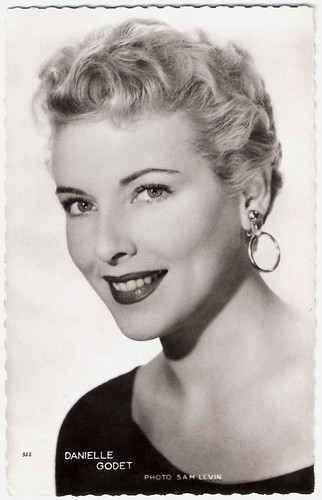
French postcard by Editions P.I., Paris, no. 555. Photo: Sam Lévin.

Sources: Guy Bellinger (IMDb), Marlène Pilaete (L’Encinémathèque - now defunct), Le Figaro (French), Pure People (French), Wikipedia (French) and IMDb.

This post was last updated on 10 June 2024.

28 August 2014

Vera Korène

Russian born actress Véra Korène (1901-1996) played seductive spies and vamps in the French cinema of the 1930s. After a dozen films, the Nazi occupation of France cut her screen career short.

Vera Korène
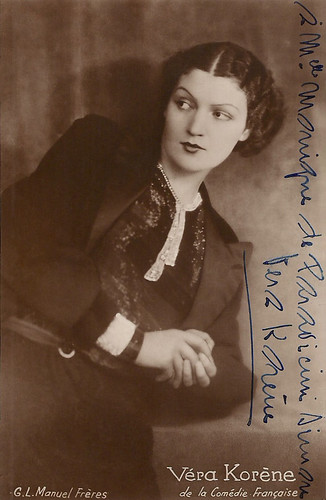
French postcard. Photo: G.L. Manuel Frères. Collection: Didier Hanson.

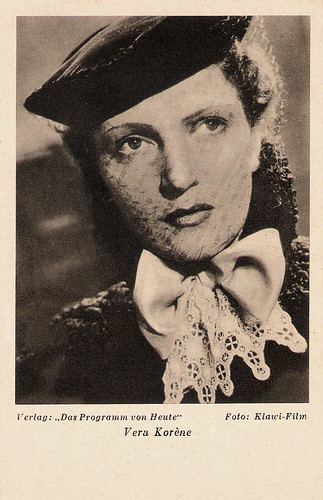
Vera Korene
German postcard by Das Programm von Heute, Berlin. Photo: Klawi-Film. Publicity still for Les bateliers de la Volga/The Volga Boatman (Vladimir Strizhevsky, 1935).

Vera Korène
French postcard by Editions Chantal, Rueil, no. 95. Photo: Studio-Iris.

Coolly elegant


Véra Korène was born as Rebecca Véra Koretzky in Bakhmut in the Russian Empire (now Artemivsk, Ukraine) in 1901. With her family, she fled the Russian Revolution of 1917 and settled in Paris, France.

There she made her film debut in the French film Son excellence le Bouif/His Excellency Le Bouif (Louis Osmont, 1922) with Tramel. Using the Francised name Korène, she made a career in the theatre and entered the prestigious Comédie-Française in 1931. In the sound era, she returned to the screen in the film La voix sans visage/The Faceless Voice (Leo Mittler, 1933) opposite Lucien Muratore and Jean Servais.

She had her breakthrough the following year with her lead role in La belle de nuit/The Beauty of the Night (Louis Valray, 1934) with Aimé Clariond. Kinsayder at IMDb: “In the dual role, the statuesque Véra Korène is coolly elegant as the actress Maryse and coldly severe as the world-weary, man-hating prostitute Maïthé. It was her second feature film [sic], but Korène was already an established stage actress and her performance here, while less alluring than that of the eroticised Marie Bell in (Jacques) Feyder's picture (Le Grand Jeu), is intense, striking and complex.”

The following year Korène played the female lead opposite Pierre Blanchar and Charles Vanel in the drama Les bateliers de la Volga/The Volga Boatman (Vladimir Strizhevsky, 1935), based on a novel by Joseph Kessel. Korène then starred as Erna Flieder, a notorious female spy of the WWI era in the Spy Film Deuxième Bureau/Intelligence Service (Pierre Billon, 1935).

Hal Erickson at AllMovie: “Though she seemingly has ice water in her veins, Erna forgets all about her mission in life when she falls in love with her AEF adversary Captain Benoit (Jean Murat). In time-honored tradition, our heroine ultimately lays down her own life to save Benoit from harm.”

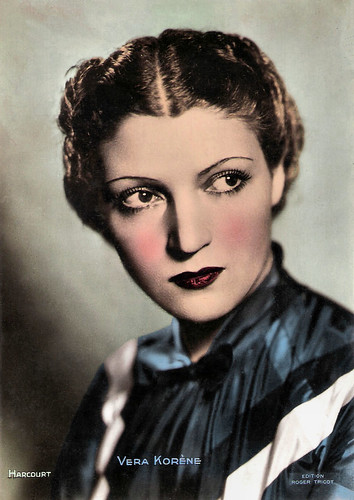
Vera Korène
French postcard by Edition Roger Tricot. Photo: Harcourt.

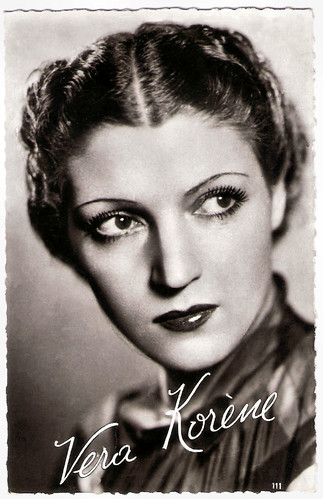
Vera Korène
French postcard by Editions et Publications Cinematographiques (EPC), no. 111. Photo: Harcourt.

Rare and subtle


In 1936, Vera Korène starred opposite Pierre Richard Willm and Olga Tschechova in L’Argent/Money (Pierre Billon, 1936). They reunited the next year in the historical drama Au service du tsar/Serving the Tsar (Pierre Billon, 1936).

In another historical drama, La danseuse rouge/The Red Dancer (Jean-Paul Paulin 1937), her co-star was Maurice Escande. The following year, she played the title role in Tamara la complaisante/Tamara (Jean Delannoy, Félix Gandéra, 1938) opposite Victor Francen.

One of her best films was the murder mystery Café de Paris (Yves Mirande, Georges Lacombe, 1938) with Jules Berry. Didier Fort at IMDb: “It's a treat. Many subplots are going on, all supported by brilliant and funny dialogs, among which the regular phone calls of a journalist (Carette) to his redaction, giving step by step the progress of the inquiry in an emphatic tone. Most of the (very numerous) cast is at his best. Above all of them, Jules Berry, rather restrained here, hence more efficient than ever, and the rare and subtle Véra Korène, acting with a 'natural' rarely seen in those times.”

She then played opposite Charles Vanel in the war drama La brigade sauvage/Savage Brigade (Marcel L'Herbier, Jean Dréville, 1939). Then Korène's promising film career was cut short by the Nazi Occupation. As a Jew, she was forbidden from acting and fled to Canada.

After the war, she returned to France. In the 1950s she organized her own theatre production company, putting on performances at the Comédie Française. In 1956 she was named director of the Théâtre de la Renaissance, a position she held until 1978. Vera Korène died in 1996 in Louveciennes, France. She was 95.

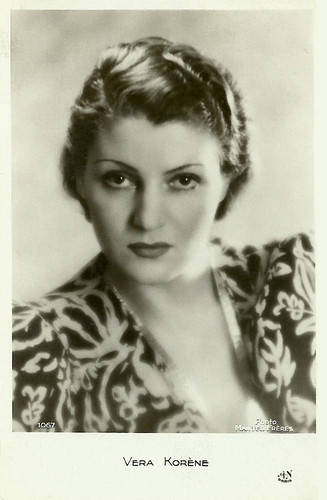
Vera Korène
French postcard by A.N., Paris, no. 1057 Photo: Manuel Frères. Collection: Didier Hanson.

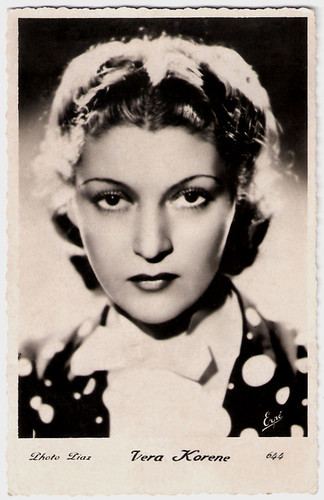
Vera Korene
French postcard by Erpé, no. 644. Photo: Piaz.

Sources: Caroline Hanotte (CinéArtistes - French), Hal Erickson (AllMovie - Page now defunct), Wikipedia (French and English) and IMDb.

This post was last updated on 4 January 2025.

27 August 2014

Dan Leno

English music hall star Dan Leno (1860-1904) was known as the ‘Funniest Man on Earth’. Short, with a wide grin, broadly comic features and a conspicuous part in his hair, he also became one of the most popular pantomime dames of the 1890s. Towards the end of his life, he made 14 short films.

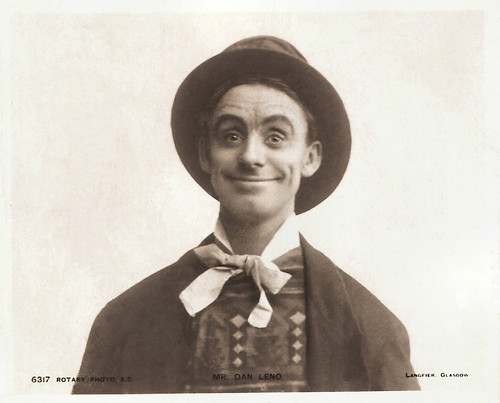
Dan Leno
Small British postcard in the Midget postcard Series by Rotary Photo EC., no. 6317. Photo: Langfier, Glasgow.

One of the highest-paid comedians in the world


Dan Leno was born George Wild Galvin in St Pancras, London, in 1890. He was the youngest of six children. His parents, John Galvin and his wife Louisa, née Dutton, performed together in a music hall double act called ‘The Singing and Acting Duettists’. They were not very successful, and the family struggled in poverty.

In 1864, at the age of four, George joined his parents on stage in their music hall act, billed as 'Little George, the Infant Wonder, Contortionist, and Posturer'. That same year, his father, an alcoholic, died at the age of 37. The family moved to Liverpool a few months later, where his mother married the comedian William Grant, a.k.a. William Leno.

In 1865, George and his brother, Henry, formed a clog dancing double act known as ‘The Great Little Lenos’. Tired of surviving on little or no money, Henry left the clog dancing act to take up a trade in London, forcing Leno to consider a future as a solo performer. He made his first solo appearance, aged nine, at the Britannia Music Hall in Coventry. In his teen years, he became the star of his family's act. Leno's clog dancing continued to be so good that in 1880, he won the world championship at the Princess's Music Hall in Leeds and won a silver belt. The judges sat under the stage and listened to the beats.

He adopted the stage name Dan Leno and, in 1884, made his first performance under that name in London. That year, he married Lydia Reynolds, a young dancer and comedy singer. As a solo artist, he became increasingly popular during the late 1880s and 1890s, when he was one of the highest-paid comedians in the world. He developed a music hall act of talking about life's mundane subjects, mixed with comic songs and surreal observations, and created a host of mostly working-class characters to illustrate his stories.

In 1886, Leno played the dame in 'Jack and the Beanstalk' at the Surrey Theatre. Such was his success that Augustus Harris hired him as dame at Drury Lane for the 1888 production of 'Babes in the Wood'. He became one of the greatest and most popular of all pantomime dames and continued to play during the Christmas season at Drury Lane for the next 15 years.

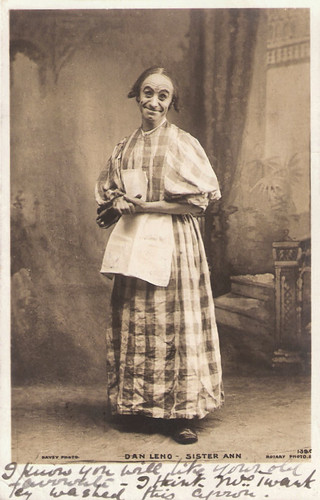
Dan Leno, Sister Ann
British postcard by Rotary photo, no. 139C. Photo: Davey Photo. Leno in costume as Sister Ann(e) in the pantomime 'Bluebeard' (1901) by J. Hickory Wood and Arthur Collins. Leno starred opposite Herbert Campbell's Bluebeard.

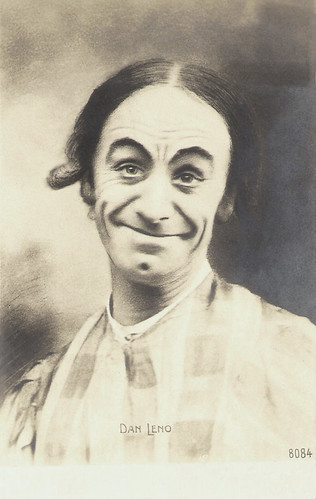
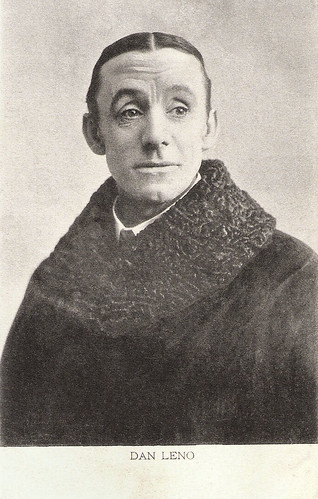
Dan Leno
British postcard by Rotophot, no. 8084. Photo: Davey, Islington.

The king's jester


The highly paid Dan Leno was generous and active in charitable causes, especially to benefit performers in need. He continued to appear in musical comedies and his own music hall routines until 1902, although he suffered increasingly from alcoholism. This, together with his long association with dame and low comedy roles, prevented him from being taken seriously as a dramatic actor, and he was turned down for Shakespearean roles.

Between 1901 and 1903, Leno recorded more than twenty-five songs and monologues on the Gramophone and Typewriter Company label. Towards the end of his life, he also made 14 short films distributed by the Warwick Trading Company or British Mutoscope & Biograph Company, including Dan Leno's Attempt to Master the Wheel (1900), An Obstinate Cork (1902), and Dessert at Dan Leno's House (1902). In these crude silent shorts he portrayed a bumbling buffoon who struggles to carry out everyday tasks, such as riding a bicycle or opening a bottle of champagne.

In 1901, Leno, along with Seymour Hicks and his wife, the actress Ellaline Terriss, was invited to Sandringham House to take part in a Royal Command Performance to entertain King Edward VII, Queen Alexandra, their son George and his wife, Mary, the Prince and Princess of Wales. Leno performed a thirty-five minute solo act that included two of his best-known songs: ‘How to Buy a House’ and ‘The Huntsman’. As a memento, the king presented Leno with a jewel-encrusted royal tie pin, and thereafter, Leno became known as ‘the King's Jester’.

Leno was the first music hall performer to give a Royal Command Performance during the king's reign. Dan Leno had begun to drink heavily after performances, and, by 1901, like his father and stepfather before him, he had become an alcoholic. By 1902, he began to behave erratically and furiously, and he suffered a mental breakdown in early 1903. He was committed to a mental asylum but was discharged later that year.

After one more show, his health declined, and he died at his home in London in 1904, aged 43. His death and funeral were national news. The Daily Telegraph wrote in its obituary: "There was only one Dan. His methods were inimitable; his face was indeed his fortune ... Who has seen him in any of his disguises and has failed to laugh?" Dan and Lydia had five children. Their three youngest children – Ernest (1889), Sidney (1891) and May (1896) followed their father onto the stage. Sidney became known as Dan Leno Jr.

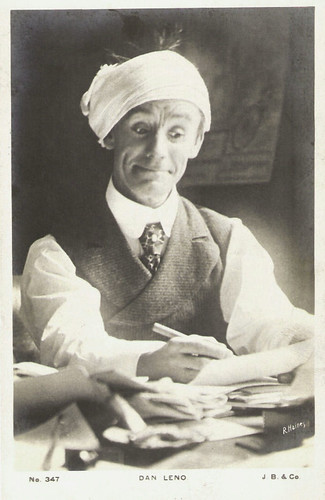
Dan Leno
British postcard by J. Beagles & Co., London, no. 347. Photo: R. Haines.

Dan Leno
British postcard in the Empire Series, London, no. 45.

Sources: Victoria and Albert Museum, Wikipedia and IMDb.
This post was last updated on 16 March 2025.

26 August 2014

Dolly Davis

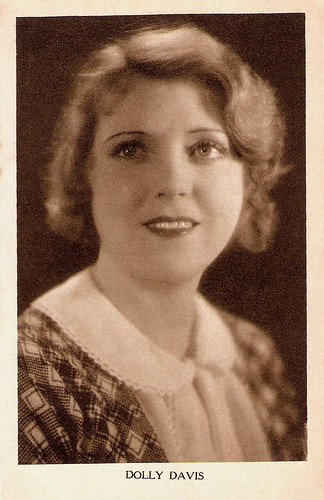
French actress Dolly Davis (1896-1962) was a very popular comédienne in the 1920s. She was often paired with André Roanne, and they even performed in a film simply called Dolly (Pierre Colombier, 1928).

Dolly Davis
French postcard in the 'Les Vedettes de Cinéma' Series by A.N., Paris, no. 112. Photo: G.L. Manuel Freres.

Dolly Davis
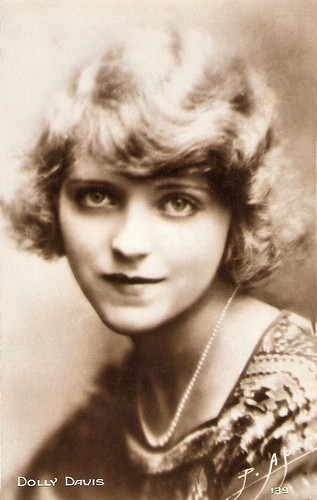
French postcard by Cinémagazine-Edition, Paris, no. 139. Photo: P. Apers.

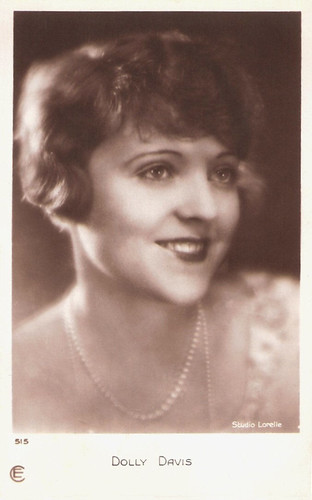
Dolly Davis
French postcard by Cinémagazine-Edition, Paris, no. 515. Photo: Studio Lorelle.

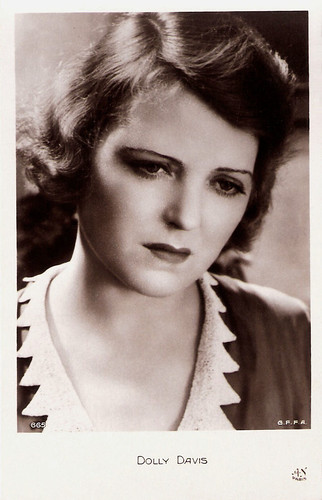
Dolly Davis
French postcard by A.N., Paris, no. 665. Photo: G.F.F.A.

Dolly Davis
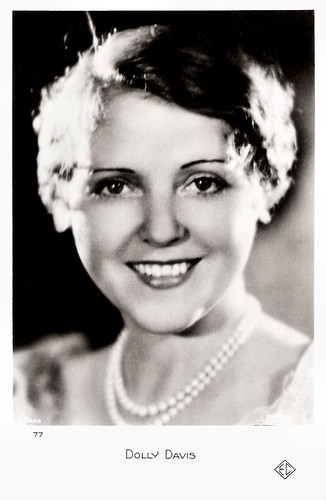
French postcard by Edition Chantal, Paris, no. 77.

The imaginary voyage


Dolly Davis was born Julienne Alexandrine David in the twentieth arrondissement of Paris, France, in 1896. The ravishing young girl posed for painters before making her film debut.

She already made her first film in 1919: La bourrasque/The Gust of Wind (Charles Maudru, 1919). She followed it up with Un conte de Noël/A Christmas Story (?, 1920) and Les étrennes à travers les âges/New Year's Gifts Through the Ages (Pierre Colombier, 1920).

She was much beloved in films such as the serial Vidocq (Jean Kemm, 1922) starring René Navarre as Vidocq, Genevieve (Léon Poirier, 1923) with Pierre Blanchar, Paris (René Hervil, 1924) with Marie Bell, and Mon frères Jacques/My Brother Jacques (Marcel Manchez, 1925) with Enrique Rivero.

A highlight was the fairytale-like Le voyage imaginaire/The Imaginary Voyage (René Clair, 1925) with Albert Préjean. Another success was Paris en cinq jours (Pierre Colombier, Nicolas Rimsky, 1926), a comedy about Americans in Paris.

With André Roanne, she appeared in the light comedy La petite chocolatière/The Chocolate Girl (René Hervil, 1927) and La femme du voisin/The Neighbour's Wife (Jacques de Baroncelli, 1928).

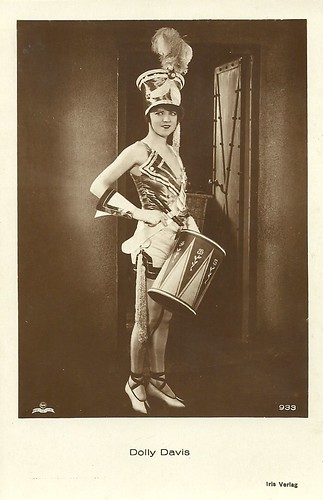
Dolly Davis
Austrian postcard by Iris Verlag, no. 933. Collection Didier Hanson.

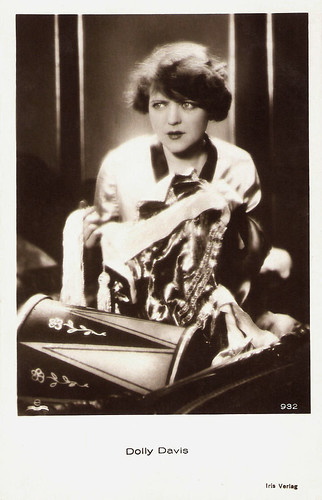
Dolly Davis
Austrian postcard by Iris Verlag, no. 932.

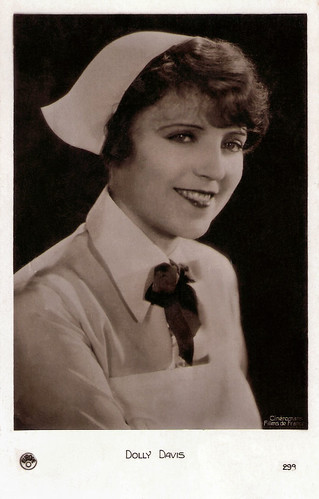
Dolly Davis
French postcard by Europe, no. 299. Photo: Cinéromans / Films de France.

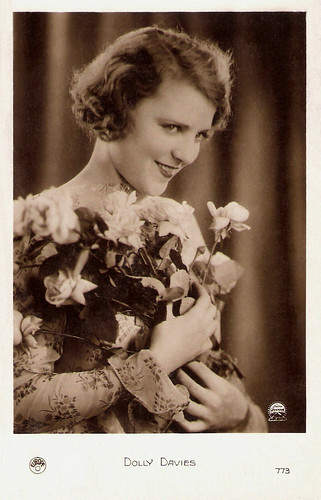
Dolly Davis
French postcard by Europe, no. 773. Photo: Paramount.

Dolly Davis
Belgian postcard by N.V. Universum, Antwerpen.

Tingel tangel


In 1928 Dolly Davis played in the American silent film Lights of Paris, shot in Paris and directed by Pierre Hemp. She played a young French girl from a small town who runs away to Paris to gain fame and fortune in the nightclub circuit.

In the late silent era, Davis also performed in various German films like Fraulein Josette - Meine Frau/A Marriage of Convenience (Gaston Ravel, 1926), Tingel tangel (Gustav Ucicky, 1927) with Paul Hartmann, Verirrte Jugend/Misled Youth (Richard Löwenbein, 1928), Frauenraub in Marokko/The Love of a Sheik (Gennaro Righelli, 1928) opposite Vladimir Gajdarov, Die weisse Rosen von Ravensberg/The White Roses of Ravensberg (Rudolf Meinert, 1929) starring Italian diva Diana Karenne, and a film directed by actress Olga Tschechowa: Der Narr seiner Liebe/Fool For Love (1929), starring Michael Chekhov.

When sound came along, Davis starred in La dernière berceuse (Jean Cassagne, Gennaro Righelli, 1930), the French language version of the first Italian sound film, La canzone dell'amore/The Song of Love (Gennaro Righelli, 1930), in which she played a young student who had to break off her engagement because of a baby her mother had with a stranger and left to her when she died. Seeing her life shattered, she tried to commit suicide, but her fiancé arrived in time. She followed this with the French comedy Un trou dans le mur (René Barberis, 1930) with Jean Murat.

More little-known French sound films followed including Gagne ta vie/Earn Your Living (André Berthomieu, 1931), Brumes de Paris/Mists of Paris (Maurice Sollin, 1932), Un train dans la nuit/A Train in the Night (René Hervil, 1934), and Bichon (Fernand Rivers, 1935), in which all the members of a family become agitated around a baby.

Davis reunited with her husband André Roanne in the sentimental comedy L'école des vierges/The Virgin School (Pierre Weill, 1935), in which she was convinced that he was cheating on her and decided to do the same, but the irreparable was avoided in time.

After Bar du sud/Southern Bar (Henri Fescourt, 1938) starring Charles Vanel, Dolly Davis retired. She was 42. From then on, she dedicated her time to painting, and she died in 1962 in Neuilly-sur-Seine, France.

Dolly Davis, publicity for Campari
French postcard. Photo: Studio Lorelle. Caption: "Si Paris vous attire, Campari vous retient."

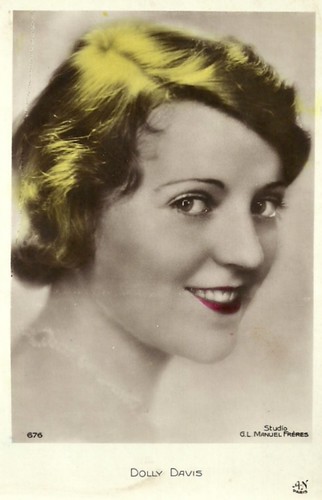
Dolly Davis
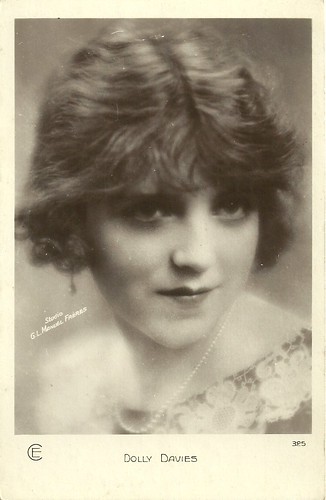
French postcard by A.N., Paris, no. 676. Photo: Studio G.L. Manuel Frères.

Dolly Davis
French postcard by Editions Cinémagazines, no. 325. Photo: Studio G.L. Manuel Frères.

Dolly Davis
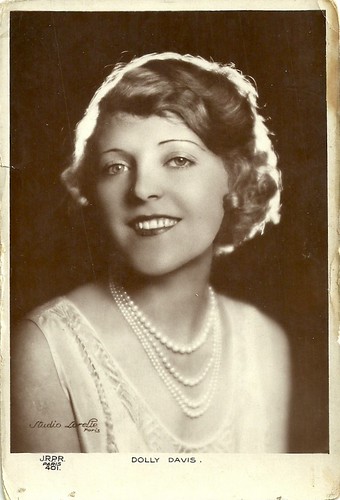
French postcard by J.R.P.R., Paris, no. 401. Photo: Studio Lorelle, Paris.

Dolly Davis
French postcard by EC (Editions Chantal), Paris, no. 77. Photo: Piaz.


Scene from Le voyage imaginaire/The Imaginary Voyage (1925). Source: Maxence Cyrin (Cinemix).

Sources: Thomas Staedeli (Cyranos), Gary Richardson (CineArtistes.com - French), Wikipedia (French), and IMDb.
This post was last updated on 3 December 2023.

24 August 2014

Homunculus (1916)

The third film special in our new weekly series is about Homunculus (Otto Rippert, 1916). This silent super-serial was part of the German artificial-creature film genre, including Der Golem (1914 and 1920), Alraune (1918, 1928, 1930) and Metropolis (1926). Danish star Olaf Fönss played the perfect creature, manufactured in a laboratory. During World War I, Homunculus was the most popular and influential serial in Germany. It even influenced the fashion in Berlin.

Olaf Fönss
German postcard by Verlag Hermann Leiser, Berlin-Wilm., no. 9667/1. Photo: DBG (Deutsche Bioscop-Gesellschaft). Publicity still for Homunculus, 1. Teil/Homunculus (1916).

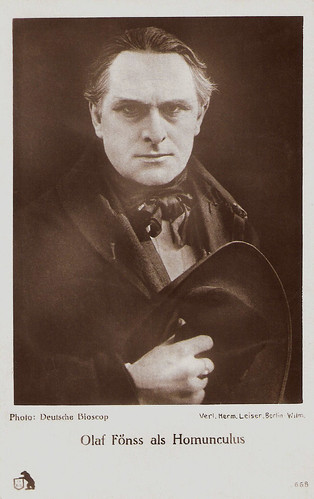
Olaf Fönss as Homunculus
German postcard by Verlag Hermann Leiser, Berlin-Wilm., no. 9668. Photo: DBG (Deutsche Bioscop-Gesellschaft). Publicity still for Homunculus, 1. Teil/Homunculus (1916).

Little human


After having played in Danish films in the early and mid-1910s, Olaf Fönss tried his luck in Germany in 1915.

He immediately became the protagonist of the serial Homunculus, written by Robert Reinert, directed by Otto Rippert and released in 1916.

The script was written by Fritz Lang, and the film foreshadows various elements of his film Metropolis (Fritz Lang, 1929), which will be the subject of EFSP's film special next Sunday.

Homunculus is an artificial creature, test tube bred in a lab by Dr. Hansen (Theodoor Loos) and his assistant Edgar Rodin (Friedrich Kühne). They call their created baby 'Homunculus', Latin for 'little human.

Homunculus is brought up thinking he is a normal man. After learning of his true identity, the adult Homunculus understands he has no soul and is incapable of love. He hates Hansen for making him. Hansen's daughter loves Homunculus, but he is unable to feel much beyond hate.

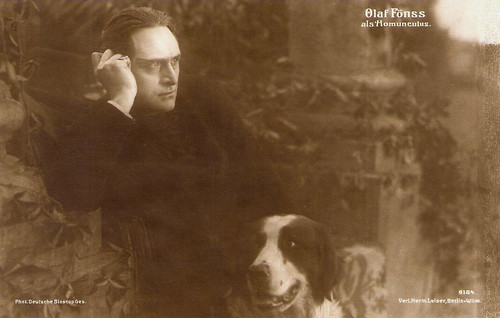
Homunculus leaves, haunted by the incapability to feel human emotions. During his travels, he adopts a stray dog, feeling pity - if not love. He instigates revolutions and becomes a monstrous but beautiful tyrant, relentlessly pursued by his creator-father who seeks to rectify his mistake.

Olaf Fönss in Homunculus
German postcard by Verlag Hermann Leiser, Berlin-Wilmersdorf, no. 9184. Photo: DBG (Deutsche Bioscop-Gesellschaft).

Olaf Fönss as Homunculus
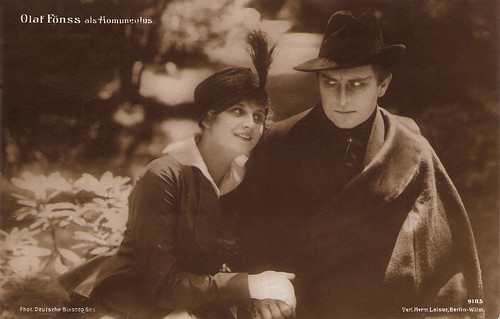
German postcard by Verlag Hermann Leiser, Berlin-Wilm., no. 9185. Photo: DBG (Deutsche Bioscop-Gesellschaft). Publicity still for Homunculus, 1. Teil. Der künstliche Mensch/Homunculus (Otto Rippert, 1916) with Olaf Fönss as Homunculus and Aud Egede Nissen.

Olaf Fönss in Homunculus, 2
German postcard by Verleih Hermann Leiser, Berlin, no. 9186. Photo: DBG (Deutsche Bioscop-Gesellschaft). Publicity still for Homunculus, 2. Teil. Das geheimnisvolle Buch/Homunculus. The mysterious book (Otto Rippert, 1916).

Olaf Fönss in Homunculus 3. Die Liebeskomödie des Homunculus
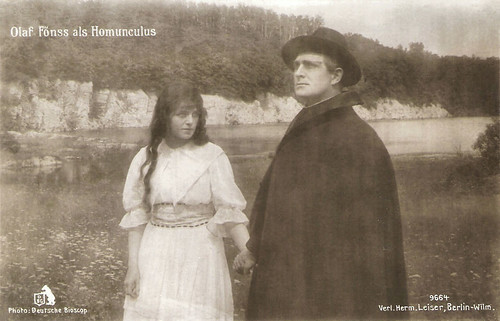
German postcard by Verlag Herm. Leiser, Berlin, no. 9664. Sent by mail in 1917. Photo: DBG (Deutsche Bioscop-Gesellschaft). Publicity still for Homunculus 3. Die Liebeskomödie des Homunculus/The tragic love story of the Homunculus (Otto Rippert, 1916). The girl could be Ilse Lersen (Luise) or Erna Thiele (Anna). Before he wants to destroy the world, Homunculus wants to explore love.

Olaf Fonss in Homunculus, 3
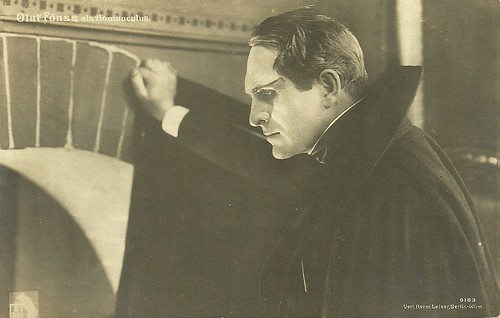
German postcard by Verlag Herm. Leiser, Berlin, no. 9183. Photo: DBG (Deutsche Bioscop-Gesellschaft). Publicity still for Die Liebeskomödie des Homunculus/The tragic love story of the Homunculus (Otto Rippert, 1916).

Olaf Fönss in Homunculus, 5
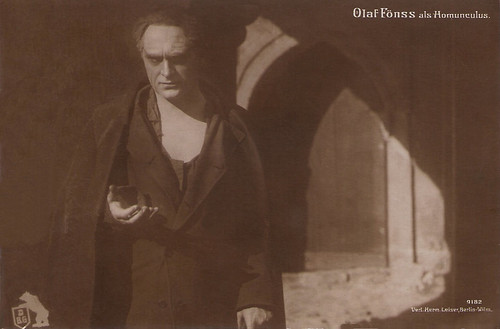
German postcard by Verlag Herm. Leiser, Berlin, no. 9182. Photo: DBG (Deutsche Bioscop-Gesellschaft). Publicity still for Homunculus, 5. Teil. Die Vernichtung der Menschheit/Homunculus. The Destruction of Mankind (Otto Rippert, 1916).

Wonderful photography


Homunculus was set up as a super-serial, composed of six feature-length episodes. It was meant to play not only as a serial, but as a series.

Bob Lipton notes at IMDb that the film "has some wonderful photography [by Carl Hoffmann] (notice the strong use of framing not by irising, as was still very common at this time, but by using structure and set decoration to change the effective frame size) and toning (a process in which the black silver nitrate is replaced by other compounds with colors, resulting in white whites, black blacks but colors instead of grays)".

The story asks the question: is the soul born with the body, or the gift of god?

After making Homunculus, Olaf Fönss did not stay in Berlin. He was called back to play in Danish films after Danish star Valdemar Psilander had committed suicide.

But his German film serial was a huge success during the dark years of World War I, and Homunculus would inspire many later artificial human films, including James Whale's horror classic Frankenstein (1931) featuring Boris Karloff as Frankenstein's monster.

Prints of Homunculus exist in the George Eastman House film archive (only a 1920 coloured re-release version of about 75 min. with Italian language intertitles, preserved in 2002); in the Bundesarchiv-Filmarchiv (one black & white episode); in the Národní Filmovy Archiv (one black & white episode); and in the Cinémathèque Suisse film archive (250 metres).

Olaf Fönss
German postcard by Verlag Herm. Leiser, Berlin, no. 5017.

Olaf Fönss as Homunculus
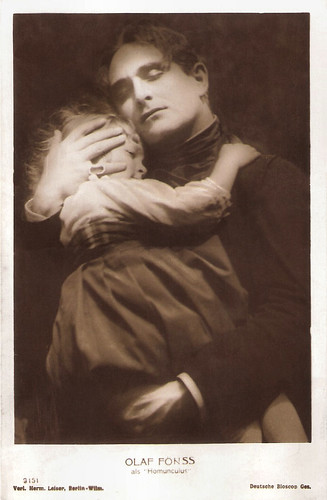
German postcard by Verleih Hermann Leiser, Berlin, no. 9151. Photo: DBG (Deutsche Bioscop-Gesellschaft). Publicity still for Homunculus, 1. Teil/Homunculus (Otto Rippert, 1916).

Sources: Bob Lipton (IMDb), Stephen Prince (The Horror Film), Silent Era, Wikipedia, and IMDb.
23 August 2014

Siegfried Breuer

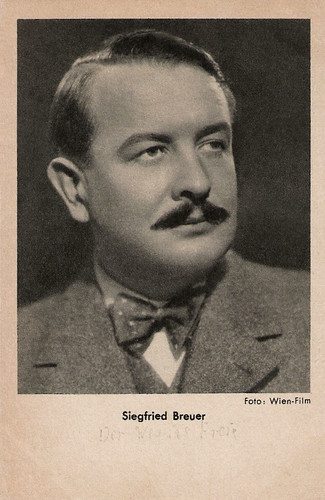
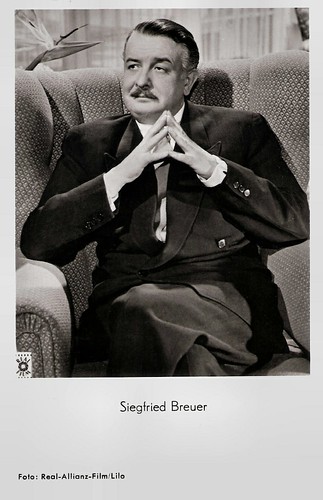
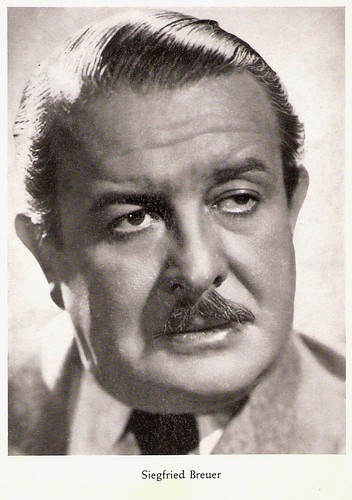
Austrian stage actor Siegfried Breuer (1906-1954) made his film debut late at the age of 33, but in the next 15 years, he starred as a charming bon vivant with a raised left eyebrow. Among his 50 films are many Viennese comedies, some Nazi propaganda films and the classic The Third Man (1949). Breuer was also an occasional film director and screenwriter.

Siegfried Breuer
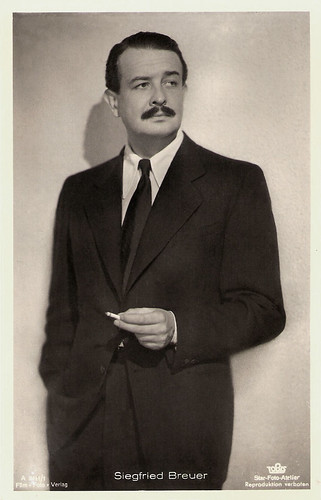
German postcard by Film-Foto-Verlag, no. A 3441/1, 1941-1944. Photo: Star-Foto-Atelier / Tobis.

Siegfried Breuer
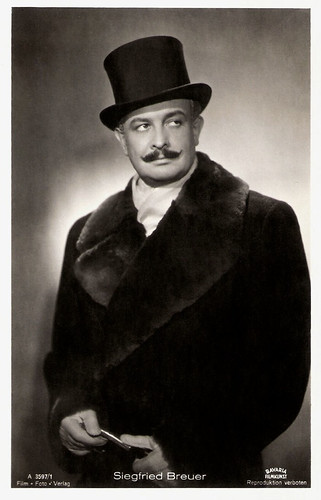
German postcard by Film-Foto-Verlag, no. A 3597/1, 1941-1944. Photo: Bavaria Filmkunst.

An elegant but sinister seducer


Siegfried Breuer was born in Vienna, Austria in 1906. He was the son of the German actor and opera singer Hans Breuer. His godfather was Siegfried Wagner. So performing was in young Siegfried’s blood. In the early 1920s, he attended the Akademie für Musik und Darstellende Kunst (Academy of Music and Performing Arts) in Vienna, where he studied alongside Paula Wessely and Käthe Gold.

In 1924, he made his stage debut at the Volkstheater in Vienna and later played there at the Theater in der Josefstadt. In Berlin, he performed his first leading role in the classic play Der Prinz von Homburg (The Prince of Homburg) by Heinrich von Kleist under the direction of Max Reinhardt. In 1935 he became a permanent member of the ensemble cast of Reinhardt's prestigious Deutschen Theaters (till 1941). After some 15 years of stage acting the then 33 years old Siegfried Breuer made his screen debut in the short Eins zu Eins/One to One (Carl Prucker, 1939). However, in 1931 he had already played a bit part in the comedy Wochenend im Paradies/Weekend in Paradise (Robert Land, 1931) starring Trude Berliner.

He was immediately much in demand, and that same year, he added his Viennese charm to Unsterblicher Walzer/Immortal Waltz (E.W. Emo, 1939) with Paul Hörbiger as Johann Strauss, Mutterliebe/Mother Love (Gustav Ucicky, 1939), the comedy Anton, der Letzte/Anthony the Last (E.W. Emo, 1939) with Hans Moser, and the Anti-Semitic Nazi propaganda film Leinen aus Irland/Linen for Ireland (Heinz Helbig, 1939).

During the war years, Breuer played an elegant but sinister seducer in the Alexander Pushkin adaptation Der Postmeister/The Postmaster (Gustav Ucicky, 1940) with Heinrich George and Hilde Krahl, and in the classic Romanze in Moll/Romance in Moll (Helmut Käutner, 1943) with Marianne Hoppe.

But he also served the stereotype of the evil Jew in such anti-Semitic productions as Der Weg ins Freie/The way out (Rolf Hansen, 1941) starring Zarah Leander, and Venus vor Gericht/Venus in court (Hans H. Zerlett, 1941) with Hannes Stelzer.

Siegfried Breuer
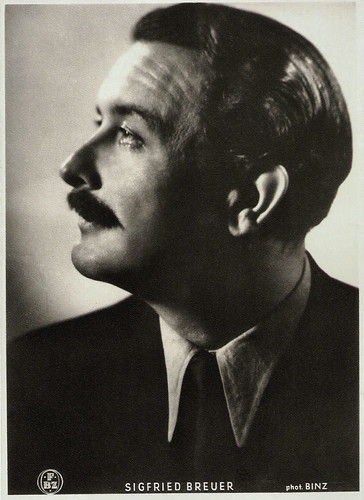
German postcard by FBZ (Film-Bild-Zentrale). Photo: Binz.

Siegfried Breuer
German postcard by Das Programm von Heute. Photo: Wien-Film.

Harry Lime's friend


Between 1939 and 1954, Siegfried Breuer would star in 50 films. After the war, he was seen in a supporting part in the colour film adaptation of the operetta Die Fledermaus/The Bat (Géza von Bolváry, 1946) with Marte Harell and Johannes Heesters. Die Fledermaus was already shot in 1944, but the film material seemed lost after the bombings. In 1946, the material was found and finally edited.

One of the most famous films in which Breuer appeared is the British film noir The Third Man (Carol Reed, 1949), situated in allied-occupied Vienna. Breuer played the Romanian Popescu, one of the black marketers and friends of the mysteriously killed Harry Lime (Orson Welles). Popescu was a small part but one which is integral to the development of the story.

Another success was the come-back film of Zarah Leander, the musical drama Gabriela (Géza von Cziffra, 1950), co-starring Carl Raddatz, Vera Molnar and Breuer. Gabriela was the third highest-grossing film at the West German box office in 1950.

Breuer directed, wrote and starred in the film Der Schuß durchs Fenster/The Shot through the Window (Siegfried Breuer, 1950) in which he worked with Curd Jürgens. He also directed the comedies Seitensprünge im Schnee/Escapades in the Snow (Siegfried Breuer, 1950) with Doris Kirchner, and In München steht ein Hofbräuhaus/In Munich stands a Hofbräuhaus (Siegfried Breuer, 1951) with Fita Benkhoff and Paul Kemp.

Siegfried Breuer was a heavy smoker. He died of a combination of liver disease and pneumonia in 1954 in Weende near Göttingen in the South of Germany. He was only 47. Breuer was married six times, among others with the actresses Maria Andergast, Eva-Maria Meineke and Lia Condrus. His sons Walter Breuer a.k.a. Siegfried Breuer Jr. and Wolfgang Breuer a.k.a. Wolfgang Condrus and his grandchildren Jacques Breuer and Pascal Breuer also worked in the entertainment industry.

Siegfried Breuer
German postcard by Film-Postkartenverlag, Hamburg-Bergedorf, no. 120. Photo: Real-Film. Publcity still for Gabriela (Géza von Cziffra, 1950).

Siegfried Breuer
German collectors card.

Sources: I.S. Mowis (IMDb), Stephanie D'heil (Steffi-line) (German), Wikipedia (English and German), and IMDb.
This post was last updated on 9 August 2023.