
British postcard by Rotary Photo, E.C., no. 4018 J. Photo: Foulsham & Banfield.
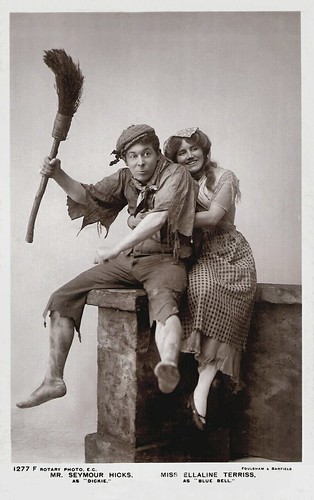
British postcard by Rotary Photo, E.C., no. 1277 F. Photo: Foulsham & Banfield. Seymour Hicks as Dickie and Ellaline Terriss as Blue Bell in the play 'Bluebell in Fairyland' (1901).

British postcard by Rotary Photo, E.C., no. 1597 Q. Seymour Hicks and Ellaline Terriss in the play 'The Beauty of Bath' (1906).

British postcard by Rotary Photo, no. 11509 D. Photo: Foulsham & Banfield. Ellaline Terriss as Duc du Richelieu in the musical play, 'The Dashing Little Duke', by her husband, Seymour Hicks, with lyrics by Ardian Ross and music by Frank E. Tours. The production, the cast of which also included Hayden Coffin, Courtice Pounds, Elizabeth Firth and Coralie Blythe, opened at the Hicks Theatre (now the Gielgud), London, on 17 February 1909, following an out-of-town trial at the Theatre Royal, Nottingham. It ran for a disappointing 95 performances.
The most popular couple on the London stage
Ellaline Terriss's real name was Mary Ellaline Lewin, and she was born in 1871 in Port Stanley, the capital of the British colony of the Falkland Islands. Her father, William Lewin, was a cattle farmer there. Her mother, Isabel (née Lewis), acted under the stage name Amy Fellowes. Her adventurous father had been a sailor and tea farmer, as well as an actor, before raising sheep in the South Atlantic. Shortly after Ellaline's birth, he returned to England, where he became a great success as an actor under the stage name William Terriss. Because of his swashbuckling style, he was known as 'Breezy Bill'. Ellaline's brother, Tom Terriss, became an actor, screenwriter and well-known film director.
Ellaline performed from an early age, although she had no real ambition to act professionally. At 17, she appeared in pantomime at the Alexandra Theatre, Liverpool. Wikipedia: "Petite, pretty and talented, she attracted the praise of both critics and the public. She came to the attention of Herbert Beerbohm Tree, who signed her to make her professional London debut." She debuted on the London stage as Mary Herbert in 'Cupid's Messenger' (1888). Terriss won over critics and audiences alike. She landed a three-year contract with producer Charles Wyndham, her first role being Madge in 'Why Women Weep'. Ellaline also attracted the attention of a promising actor, Seymour Hicks, whom she married in 1893.
In December 1893, Terriss starred in the title role of the successful and lavish version of the fairy pantomime 'Cinderella', produced by Henry Irving with music by Oscar Barrett. Toward the end of the run, Hicks took over the role of Thisbe, one of Cinderella's half-sisters. The play was performed in the United States under the management of George Edwardes. The following season, Terriss performed in W. S. Gilbert and Frank Osmond Carr's comic opera 'His Excellency'. In 1895, Terriss worked in London with her husband as co-star in a George Edwardes hit, 'The Shop Girl', which they reprised on Broadway. They travelled to the United States in 1895, where they befriended the novelist Richard Harding Davis. At W.S. Gilbert's urging, Hicks wrote a drama called 'One of the Best, a vehicle for Terriss's father's show at the Adelphi Theatre, based on the famous Dreyfus case. Another of the couple's early successes was 'The Circus Girl' (1896). Terriss made Lionel Monckton's song, 'A Simple Little String' from 'The Circus Girl' into a major hit.
In December 1897, William Terriss was murdered outside the Adelphi Theatre in London's West End by an unemployed, deranged actor, Richard Archer Prince, who thought Terriss had been blackballing him. Ellaline's mother died shortly afterwards. The murder and Prince's trial occupied the nation's press for weeks. At the time, the most popular couple on the London stage, Terriss and Hicks, received a great deal of sympathy. In the aftermath, Terriss starred in the title role of a new play co-authored by Hicks, 'A Runaway Girl' (1898), which was one of the Gaiety Theatre's most successful shows. This was followed by 'With Flying Colours' (1899).
The Hickses teamed up with producer Charles Frohman. Over seven years, they performed in his company in a series of musicals written by Hicks. These included 'Bluebell in Fairyland' (1901) with music by Charles H. Taylor, 'The Cherry Girl' (1902), 'The Beauty of Bath' (1906), which included lyrics and additional music by P. G. Wodehouse and Jerome Kern, and opened the Hicks Theatre, and 'The Gay Gordons' (1907). Hicks and Terriss also starred in 'Quality Street' in 1902.

British postcard by Rotar Photo, E.C., no. 4051 A. Photo: Foulsham & Bansfield. Caption: Mrs. Seymour Hicks (Miss Ellaline Terriss), Baby Betty and Mr. Seymour Hicks.

British postcard by Rotary Photo, E.C., no. 4857 N. Photo: Foulsham & Banfield. Ellaline Terriss as Peggy Quainton in 'The Gay Gordons' (1907), an Edwardian musical comedy with a libretto by Seymour Hicks, music by Guy Jones and lyrics by Arthur Wimperis, C. H. Bovill, Henry Hamilton and P. G. Wodehouse. The title refers to both the Clan Gordon and the famed Scottish regiment, the Gordon Highlanders, as the plot involves the heir to the clan and a soldier from the regiment. The original production was produced by Charles Frohman and opened at London's Aldwych Theatre on 11 September 1907. The piece starred Hicks as Angus Graeme and Terriss as Peggy Quainton. William Lugg played Andrew Quainton, Zena Dare played Victoria Siddons, and when the show went on tour, she played Peggy Quainton.

British postcard by Rotary Photo E.C., no. 4409 F. Photo: Foulsham & Banfield. Caption: Miss Betty & Mrs. Seymour Hicks (Miss Ellaline Terriss). As Betty Hicks was born in 1907, this photo may be of ca. 1910.

British postcard by Rotary Photo, E.C., no. 1277 G. Photo: Foulsham & Banfield. Seymour Hicks as Dickie and Ellaline Terriss as Blue Bell in 'Bluebell in Fairyland' (1901).
Acting in nearly a dozen British and American films
Ellaline Terriss and Seymour Hicks continued to perform consistently, both in London and on tour in the United States. There was an intermission when Terriss adopted their first child, Mabel, in 1904. In 1905, Terriss took over the role of Angela in her husband's play 'The Catch of the Season', which had been played by Zena Dare during Terriss's pregnancy. Terriss later ceded the role to Dare's sister, Phyllis Dare. After the birth of her second daughter, Betty, in 1907, Terriss reduced the steady activity she had maintained for nearly twenty years. She continued to work in a limited number of plays, including 'The Dashing Little Duke' (1909), with C. Hayden Coffin, Courtice Pounds and Louie Pounds. Although she played the title role, the production had little success. When she missed several performances due to illness, Hicks replaced her in the role - possibly the only instance in the history of a musical in which a husband replaced the wife.
After the failure of 'Captain Kidd' (1910), Hicks and Terriss concentrated on comedy and music hall tours. They did a tour in South Africa in 1911 and a subsequent tour of France after the outbreak of World War I to give concerts to British troops stationed at the front. Her only return to musical comedy, 'Cash on Delivery' (1917), confirmed the decision to turn her career around. From 1917 onwards, Terriss returned to the stage only on special occasions. In December 1925, she performed at the Lyceum with her husband in 'The Man in Dress Clothes', a French farce which he had translated, and in which their daughter Betty made her debut. It was intended to run for a short season, but it was such a success that performances were extended.
Terriss also acted in nearly a dozen British and American films. She made her screen debut in My Indian Anna (Arthur Gilbert, 1907), followed by Glow Little Glow Worm, Glow (Arthur Gilbert, 1907). In 1913-1914, she acted in three films with her husband Seymour Hicks: Scrooge (1913), David Garrick (1913), and Always Tell Your Wife (1914). All were directed by Leedham Bantock. She then moved to the United States to act in two films directed by her brother, Tom Terriss, for his own company, Terriss Feature Film Company, starting with The Flame of Passion (1915), which was shot in Jamaica. Tom Terriss often played the male lead in his own films, including in this one. After a second film by Tom Terriss, A Woman of the World (1916), Ellaline returned to Britain. Tom, after eight films for his own company, started to work for Vitagraph and hence focused on directing.
In 1923, Seymour Hicks and Ellaline Terriss did a remake of Always Tell Your Wife, for which Alfred Hitchcock took over direction after the initial director, Hugh Croise, was fired. In the late 1920s, Terriss acted opposite Lillian Hall-Davis in Blighty (Adrian Brunel, 1927) and opposite Robin Irvine in the Spy film Land of Hope and Glory (Harry Knoles, 1927). In 1929, she acted in her first talking picture, the Titanic disaster-film Atlantic by E.A. Dupont, opposite John Stuart and Madeleine Carroll. This was followed by parts in the films A Man of Mayfair (Louis Mercanton, 1931) and Glamour (Seymour Hicks, Harry Hughes, 1931) with her husband as co-director and star. In The Iron Duke (Victor Saville, 1934), she played Lady Wellington opposite George Arliss as Arthur Wellesley, the first duke of Wellington, who faced down Napoleon's armies at Waterloo, and served as prime minister. Her last film was the thriller The Four Just Men (Walter Forde, 1939) starring Hugh Sinclair and Griffith Jones.
Seymour Hicks was knighted in 1934, which made Ellaline 'Lady Hicks'. In 1940, Terriss and Hicks went to the Middle East to entertain the British troops in World War II. After the war, Terriss retired from the stage. She and Hicks moved to South Africa, where she took up painting and was tutored by the marine artist George Pilkington. So good were her works that an exhibition was held at Foyle's Art Gallery, London, in 1959. Ellaline Terriss was married to Seymour Hicks until he died in 1949. Terriss died at the Holy Family Nursing Home, Hampstead, London, in 1971, at the high age of 100. Her daughter, Betty Hicks, was a stage actress as well.

British postcard by Rotary Photo, E.C., no. 4857 V. Photo: Foulsham & Banfield. Ellaline Terriss as Peggy Quainton in 'The Gay Gordons' (1907).

British postcard by Rotary Photo, E.C., no. 4081 X. Photo: Foulsham & Banfield.

British postcard by Rotary Photo E.C., no. 7401 E. Photo: Foulsham & Banfield. Caption: Father, this is the man I love. Barbara Deane, Ellaline Terriss, Seymour Hicks, William Lugg and Zena Dare in 'The Gay Gordons' (1907).

British postcard by J. Beagles & Co., no. 2. Photo: Ellis and Walery. Seymour Hicks and Ellaline Terriss as Pierrot and Columbine.
Sources: Jon C. Hopwood (IMDb), Wikipedia (English and Spanish) and IMDb.

No comments:
Post a Comment