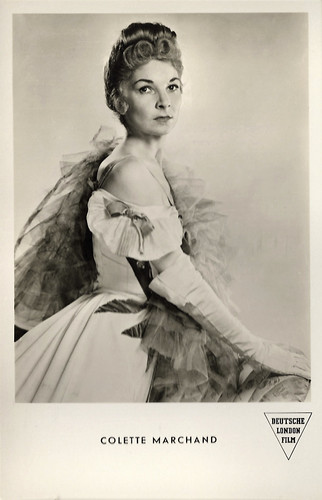
West German postcard by Kunst und Bild, Berlin W 15, no. A 818. Photo: Deutsche London Film. Colette Marchand in Moulin Rouge (John Huston, 1952).

West German postcard by Ufa/Film-Foto, Berlin-Tempelhof, no. FK 792. Photo: Joe Niczky / Oskar Film, München / Union Film. Colette Marchand in Ungarische Rhapsodie / Hungarian Rhapsody (Peter Berneis, André Haguet, 1954).
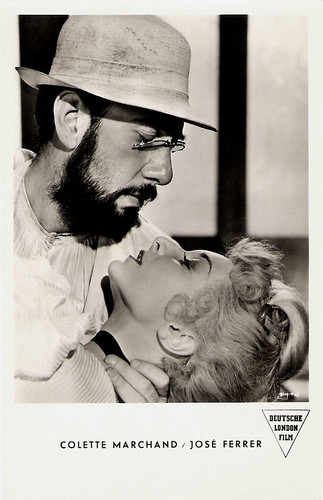
West German postcard. Photo: Deutsche London Film. José Ferrer and Colette Marchand in Moulin Rouge (John Huston, 1952).
A première ballerina on Broadway
Colette Janine Marchand was born in 1925 in Paris, France. Her parents were Roger Marchand and his wife Alice Lioret. She began her career as a student at the Paris Opéra dance school in the 1940s.
Marchand joined the corps de ballet under Serge Lifar. She left that company in 1946 and performed with the Metropolitan Ballet, a British troupe, before joining Roland Petit's Les Ballets de Paris.
There she became a prima ballerina, notably in the choreographer's creations: 'L'Œuf à la coque' (The Boiled Egg), 'Carmen', in which she reprised the title role after Zizi Jeanmaire, and 'Les Demoiselles de la nuit'.
Marchand travelled around the world as a dancer and performed with many of the great ballet dancers of the 1940s and 1950s. She performed as a première ballerina on Broadway in Les Ballets de Paris (1949 and 1950). In the 1950 show, Marchand performed 'The Boiled Egg', for which she received rave reviews.
In 1951, she had a featured role in the Broadway musical 'Two on the Aisle', by Betty Comden, Adolph Green, and Jule Styne. The show ran for 276 performances. While performing on Broadway, Marchand was featured in several magazines, including Life, and she made appearances on New York City television shows, including the Ford Star Revue, the Colgate Comedy Hour, and the Ed Sullivan Show.

West German collector card in the Kosmos-Sammelwerk series Anmut und Schönheit, no. 115 (of 200). Photo: dpa. Colette Marchand in the ballet 'Les Demoiselles de la Nuit' (1948), choreography by Roland Petit. During the height of her dance career, she was considered one of the great dancers in Europe, known as 'Les jambes' (The Legs).

French postcard by Editions du Globe, Paris, no. 217. Photo: Teddy Piaz, Paris.
A scandal at the Cannes Film Festival
Colette Marchand was considered one of the great dancers in Europe along with Violetta Elvin, Zizi Jeanmaire, Yvette Chauviré, Janine Charrat, and Margot Fonteyn.
Back in France, she lent her voice to the avant-garde film Traité de Bave et d'Éternité / Venom and Eternity (Isidore Isou, 1951). The film created a scandal at the 1951 Cannes Film Festival.
In 1952, she received a Golden Globe Award for her performance in Moulin Rouge (John Huston, 1952). She played streetwalker Marie Charlet who has a love affair with Henri de Toulouse-Lautrec (José Ferrer). She was nominated for the Academy Award for Best Supporting Actress, but Gloria Grahame won the award.
Marchand returned to her dancing career. She appeared in the ballet 'The Lady in the Ice' (1953) by Jean-Michel Damase and directed by Orson Welles. According to Welles, the show "was very successful in London, and only moderately so in Paris, where it was very badly lit". That year, she married Jacques Bazire, the musical director for the Roland Petit Ballet. The following year, she appeared in Ungarische Rhapsodie / Hungarian Rhapsody (Peter Berneis, André Haguet, 1954) with Paul Hubschmid and Michel Simon, and the French-language version, Par Ordre du Tsar / At the Order of the Czar (André Haguet, 1954.
She also appeared in the musical short Romantic Youth (1954), for which she was also the choreographer. At the end of the 1950s, she returned to classical dance with the ballets of the Marquis de Cuevas. Her career declined as she grew older. Colette Marchand died in 2015, aged 90, and was survived by her sister, Yvonne (Marchand) Le Bras.
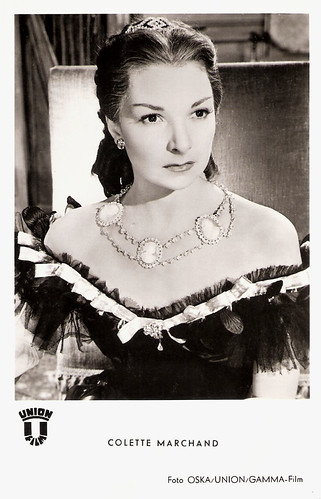
West German postcard by Kunst und Bild, Berlin, no. A 1084. Photo: Oskar / Union / Gamma-Film. Colette Marchand in Ungarische Rhapsodie / Hungarian Rhapsody (Peter Berneis, André Haguet, 1954).

West German postcard by Kolibri-Verlag. Photo: Oskar Film, München / Union Film. Colette Marchand in Ungarische Rhapsodie / Hungarian Rhapsody (Peter Berneis, André Haguet, 1954).

West German postcard by UFA/Film-Foto, Berlin-Tempelhof, no. FK 789. Photo: Joe Niczky / Oskar Film, München / Florida Films, Paris / Union Film. Colette Marchand and Paul Hubschmid in Ungarische Rhapsodie / Hungarian Rhapsody (Peter Berneis, André Haguet, 1954).
Sources: Wikipedia (French and English) and IMDb.

No comments:
Post a Comment