22 March 2016

Clara Calamai

Sultry and glamorous Clara Calamai (1909-1998) acted in many light entertainment films of the late 1930s and 1940s. However, the Italian actress is best known for her most unglamorous role. Always we will remember her as white-hot Giovanna in Luchino Visconti's early neorealist drama Ossessione/Obsession (1943).

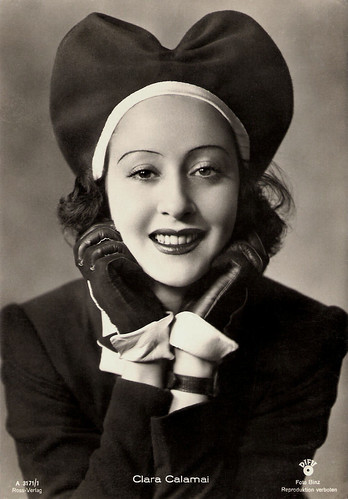
Clara Calamai
German postcard by Ross Verlag, no. A 3171/1, 1941-1944. Photo: Binz / DIFU.

Clara Calamai
German postcard by Film-Foto-Verlag, no. A 3787/1. Photo: Difu.

Clara Calamai
Italian postcard by Armando Terzoli, Roma, no. 532. Photo: Pesce. Publicity still for La Cena delle Beffe/The Jesters' Supper (Alessandro Blasetti, 1941).

Clara Calamai
Italian postcard by Ferrania.

Clara Calamai in Addio, giovinezza!
Romanian postcard. Clara Calamai as the rich seductress Elena in Addio, giovinezza! (Ferdinando Maria Poggioli, 1940), based on the play by Sandro Camasio and Nino Oxilia.

Causing a sensation


Clara Calamai was born in Prato, Tuscany, in 1909. She debuted in the film Pietro Micca (Aldo Vergano, 1938). Soon she had an intense film career.

She played in several period pieces such as La cena delle beffe/The Supper of the Pranks (Alessandro Blasetti, 1941), in which she briefly appeared with bare breasts. The scene caused a sensation. Naked breasts had seldom been seen on an Italian film screen before. A lot of people saw the film several times just for that brief scene. From most of the copies available on the commercial circuit, the scene soon disappeared: not because of the wrath of the censors, but because excited projector operators took their scissors to this bit of cinema memorabilia.

Calamai also appeared in many glamorous comedies and dramas. In 1942 Luchino Visconti prepared his film debut Ossessione/Obsession (1943) with Anna Magnani in the lead. But when the shooting started Magnani was so visibly pregnant that Visconti had to replace her. He stripped Clara Calamai of her usual glamour and turned her into Giovanna, the passionate but poor wife of a fat trattoria owner. Giovanna manages to convince her lover to kill her husband.

The film was based on James M. Cain's book The Postman Always Twice. Ossessione is quite different from the Hollywood version of The Postman Always Twice (Tay Garnett, 1946), which stars a very glamorous Lana Turner.

Memorable in Ossessione is the scene in which Giovanna falls asleep amidst an enormous amount of dirty dishes. The real eye-catcher of Ossessione is not Giovanna but Gino, the blond hunk she falls in love with, played by Massimo Girotti. At the time, Ossessione had a very short circulation in catholic, fascist Italy because of its 'amorality' and mocking of the clergy. Outside of Italy, it was shown only years after the war, because of copyright infringement. Nowadays, film historians consider it a classic of the Italian cinema.

Clara Calamai
Italian postcard by B.F.F. Edit., no. 20440. Photo: Venturini, Roma.

Clara Calamai
Italian postcard by Casa Editrice Ballerini & Fratini, Firenze, no. 21170. Photo: Bragaglia.

Clara Calamai
Italian postcard by Casa Editrice Ballerini & Fratini, Firenze, no. 4273. Photo: Bragaglia.

Clara Calamai
Italian postcard by B.F.F. Edit., no. 43070. Photo Pesce / Scalera Film.

Anna Magnani


In 1946 Clara Calamai landed again a role Anna Magnani was supposed to have played: L'adultera/The Adulteress (Duilio Coletti, 1946), for which she won a Nastro d'argento (the Silver Ribbon, a film award for cinematic performances and production by the association of Italian film critics).

Earlier the opposite had happened. Reportedly Clara Calamai was pregnant when the female lead of Roma, città aperta/Rome Open City (Roberto Rossellini, 1945) was cast. And this time Anna Magnani landed the role, and it would immortalise her.

Calamai worked again with Visconti at Le notti bianche/White Nights (Luchino Visconti, 1957), in which she played a prostitute. Visconti had suggested in Ossessione that before marrying Giovanna had also slept with men for money. In Visconti's episode La strega bruciata viva/The Witch Burned Alive of the episode film Le streghe/The Witches (Luchino Visconti, Mauro Bolognini, Vittorio de Sica, Pier Paolo Pasolini, Franco Rossi, 1966), Calamai played a small part opposite Silvana Mangano. Calamai had a well-publicised but unrequited crush on Visconti.

In the 1970s, after years of retirement, Calamai returned to the screen in Dario Argento's highly successful Horror film Profondo Rosso/Deep Red (Dario Argento, 1975). The film and her role as a murderously crazy ageing actress got a cult status among cinephiles. She spent the rest of her life in diva-like retirement, shunning the press.

Calamai was married to the aviator explorer and documentary filmmaker Leonardo Bonzi. After their divorce, she lived with Valerio Andreoli, a captain of aviation. Clara Calamai was almost 90 when she died of a stroke in Rimini in 1998. She has played in almost 50 films.

Clara Calamai
Italian postcard by St. b Angeli, Terni / A. Terzoli, Roma, no. 4.A. Photo: Bragaglia.

Clara Calamai
Italian postcard, no. 21. Photo: Ciolfi.

Clara Calamai
Italian postcard by Rizzoli, Milano, 1940. Photo: Venturini.

Clara Calamai
Italian postcard. Editor unknown.

Clara Calamai
Italian postcard by Caimo & C. - Genova. Caricature by Nino Za. Collection: Marlene Pilaete.


The famous 'nude' scene from La cena delle beffe/The Supper of the Pranks (1941). Source: Giulio Berruti (YouTube).


Scene from Ossessione/Obsession (1943). Source: K de Zwaan (YouTube).

Sources: Anne Henley (The Independent), Sandra Brennan (AllMovie), Wikipedia and IMDb.

This post was last updated on 9 September 2023.

21 March 2016

Paula Wessely

Paula Wessely (1907-2000) reigned as Austria’s most distinguished and beloved stage and screen actress almost from her debut at the Vienna Volkstheater in 1924 until her retirement in 1987. She was also criticised for her appearance in the Nazi-propaganda film Heimkehr/Homecoming (1941).

Paula Wessely
German postcard by Ross Verlag, no. 9336/1, 1935-1936.

Paula Wessely
German postcard by Ross. Photo: Terra / Baumann.

Paula Wessely
German postcard by Film-Foto-Verlag, no. A 3706/1, 1941-1944. Photo: Hämmerer / Wien Film.

Paula Wessely
German postcard by Film-Foto-Verlag, no. A 3827/1, 1941-1944. Photo: Hämmerer / Wien Film.

Paula Wessely
German postcard by Film-Foto-Verlag, no. W 80. Photo: Hämmerer / Wien Film.

Not the typical film beauty


Paula Anna Maria Wessely was born in Vienna, Austria-Hungary, now Austria, in 1907. She was the second daughter of butcher and theatre enthusiast Carl Wessely and his wife Anna Wessely-Orth. Carl Wessely’s elder sister, Josephine Wessely was an admired and successful actress of the Burgtheater in Vienna, when she died in 1887, only 27 years old.

Paula studied acting at the famous Max-Reinhardt-Seminar. In 1924, she made her debut at the Wiener Volkstheater, but she first came to attention in 1929 at the popular Theater in der Josefstadt under the direction of Max Reinhardt.

Three years later followed her breakthrough as Rose Bernd in the play by Gerhart Hauptmann. Other great stage roles were the title role in the operetta Sissy (1932) by Fritz Kreisler, Christine in the first presentation of Liebelei (Flirtation, 1933), and Gretchen in Goethe's Faust (1933) at the Salzburger Festspiele (The Salzburg Festival).

Although she was not the typical film beauty, she starred in many films. Her first major screen role was Leopoldine Dur in Maskerade/Masquerade in Vienna (Willi Forst, 1934) at the side of Adolf Wohlbrück (aka Anton Walbrook). This social comedy set in turn-of-the-century Vienna with big ball scenes was a huge success and it made Wessely one of the first stars of the Austrian stage who made a successful transition to the cinema.

The next year followed Episode (Walter Reisch, 1935), for which she won the Coppa Volpi award for Best Actress at the Venice Film Festival. Other films like Ernte/Harvest (Géza von Bolváry, 1936) and Spiegel des Lebens/Life's Mirror (Géza von Bolváry, 1938) made her a big film star of the German language cinema. Wessely was known for her sense of pathos and gentle comedy and made several appearances in musical romances.

In 1935, she married actor Attila Hörbiger, with whom she had three daughters: Elisabeth Orth (1936), Christiane Hörbiger (1938) and Maresa Hörbiger (1945). All three daughters would go on to become actresses in the Austrian cinema.

Paula Wessely
German postcard by Ross Verlag, no. 7336/1, 1932-1933. Photo: Atelier Böhm-Willott, Berlin.

Paula Wessely
Dutch postcard by M. B. & Z (M. Bonnist & Zonen, Amsterdam). Photo: City Film. Publicity still for Episode (Walter Reisch, 1935). This postcard has at the backside an advertisement for the presentation of Episode at the Harmonie Bioscoop, Tilburg.

Paula Wessely
Austrian postcard by Eberle Verlag, Wien (Vienna). Photo: I.S.B. Films.

Paula Wessely
German postcard by Das Programm von Heute, Berlin. Photo: Wien-Film / Tobis.

A Voluntary Nazi Tool


After the Anschluss of Austria in 1936, Paula Wessely became one of the most popular actresses of the Third Reich. She was affectionately called ‘Die Wessely’ by her fans. Her career thrived under Nazi rule when she starred in many projects produced under the aegis of Nazi propaganda minister Joseph Goebbels and his aides.

Till the end of war she took part in films like Ein Leben lang/A Whole Life (Gustav Ucicky, 1940) with Joachim Gottschalk, Späte Liebe/Late Love (Gustav Ucicky, 1943) and Das Herz muss schweigen/The Heart Must Be Silent (Gustav Ucicky, 1944) with Mathias Wiemann.

After the war she was accused of being a voluntary tool of the Nazis. The role she was most resented for was the lead in the anti-Polish propaganda film Heimkehr/Homecoming (Gustav Ucicky, 1941). The Americans gave her a Berufsverbot. She fell into a severe depression and was treated in a hospital. In interviews she later told that she regretted to have appeared in Heimkehr.

In 1947 she was allowed to continue her career on the Vienna stages and her fans had remained faithful to her. She was given a surprising role in the film Der Engel mit der Posaune/The Angel with the Trumpet (Karl Hartl, 1948) as a half-Jewish woman who ultimately fell victim to the Nazis. The book's author, Ernst Lothar, later wrote in his autobiography, Das Wunder des Überlebens , (The Wonder of Survival) that the Americans wanted Wessely for this role as a means of restoring her acting career: they considered the film a vehicle for helping Austrians to overcome the past. The filming promoted reconciliation over the settling of accounts. It worked.

At Film Reference, reviewer Gertraud Steiner Daviau writes: "The splendid performance of Paula Wessely also leads the film in the direction of the usual lighthearted Viennese film; Henriette appears as a positive heroine, which she definitely is not in Lothar's novel. Most viewers therefore accept the film as a generational love story set in Old Vienna rather than as a mirror of the darker side of the Austrian soul and of Austrian history."

During the 1950s Wessely had also success as a producer of her own films with her production company Paula-Wessely-Filmproduktion. To her successes belong Cordula (Gustav Ucicky, 1950), Maria Theresia (Emil E. Reinert, 1951), Der Weg in die Vergangenheit (Karl Hartl, 1954) opposite Willy Fritsch and Willi Forst, and Die unvollkommene Ehe/The Incomplete Marriage (Robert A. Stemmle, 1959) with Johannes Heesters.

In 1957 she appeared in the gay-themed film Anders als du und ich/The Third Sex (Veit Harlan, 1957) as the mother of Christian Wolff. Reportedly, heavy censorship turned the initial fairly positive theme of the film in a negative anti-gay message. The film is now a notorious curiosity in the history of the gay and lesbian cinema.

Her last film was Jedermann/Everyman (Gottfried Reinhardt, 1961) with Walter Reyer. Besides her film work, Wessely had a glittering career at the Vienna Burgtheater, where she worked since 1953 until her retirement. She was seen as the incarnation of the melancholy and the charm of an entire nation. During her career she won many prizes, including the Bambi award in 1962 and the Filmband in Gold in 1984 for her long and outstanding contributions to the German cinema.

Attila Hörbiger died in 1987, aged 91, of a stroke. Thereafter, the 'doyenne of the Vienna Burgtheater' retired at the age of 80. In her last years she lived a very secluded life in her hometown Vienna and suffered from a major depression, caused by the death of her beloved husband. They were married for 52 years. Paula Wessely died in 2000 at the venerable age of 93 in a hospital in Vienna.

Paula Wessely
German postcard by Ross Verlag, no. A 2369/1, 1939-1940. Photo: Terra.

Paula Wessely
German postcard by Ross Verlag, no. A 2957/2, 1939-1940. Photo: Wien-Film / Tobis.

Paula Wessely
German postcard by Film-Foto-Verlag, no. A 3369/1, 1941-1944. Photo: Hammerer / Wien Film / Ufa.

Paula Wessely
German postcard by Film-Foto-Verlag, no. A 3494/1, 1941-1944. Photo: Hämmerer / Wien Film.

Paula Wessely, Attila Hörbiger
With Atila Hörbiger. German postcard by Verlag und Druckerei Erwin Preuss, Dresden-Freital, Serie 1, no. 9. Photo: Charlott Serda. This is one of the first full colour star postcards.

Sources: Los Angeles Times, Thomas Staedeli (Cyranos), Gertraud Steiner Daviau (Film Reference), Encyclopedia Brittanica, Wikipedia and IMDb.

19 March 2016

Valerie Kaprisky

Stunning French actress Valérie Kaprisky (1962) is known for such films as Breathless (1983), La femme publique (1984) and Mouvements du désir (1994).

Valerie Kaprisky
Romanian postcard by Inter CONTEMPress / Publiturism.

Aphrodite


Valérie Kaprisky was born Valerie Chérès in Neuilly-sur-Seine, Hauts-de-Seine, France in 1962. Kaprisky is her Polish mother's maiden name. She is of Turkish and Argentine descent on her father's side.

During her youth in Cannes, she was inspired by the film festival to pursue an acting career. At 17, she went to Paris and started to attend the Cours Florent. In 1981 she made her film debut with a bit role in Le Jour se lève et les conneries commencent/The sun rises and the bullshit begins (Claude Mulot, 1981).

She was noticed by director Jean-Marie Poiré who offered her a part in his comedy Les Hommes préfèrent les grosses/Men Prefer Fat Girls (1981) starring Josiane Balasko.

Kaprisky had her breakthrough the next year in the French-Swiss erotic film Aphrodite (Robert Fuest, 1982), in which she played the title role opposite Horst Buchholz and Capucine. The film, inspired by the novel 'Aphrodite: mœurs antiques' by Pierre Louÿs, follows a group of people invited to a Mediterranean island for a 3-day fun and frolic fest.

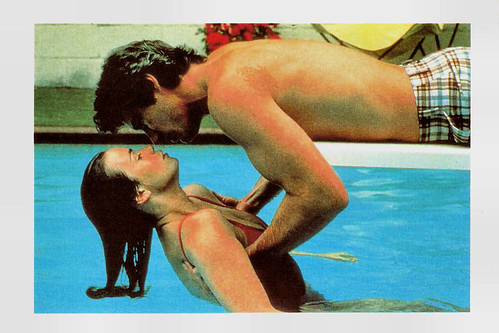
Then she made her American debut, starring alongside Richard Gere in Breathless (Jim McBride, 1983), a remake of the Nouvelle Vague classic A Bout de Souffle (Jean-Luc Godard, 1960). The original film is about an American girl and a French criminal in Paris. The remake is about a French girl and an American criminal in Los Angeles. Breathless received mixed reviews. Many critics questioned the wisdom of casting Kaprisky with her limited acting experience. The film has since gained minor cult status. Quentin Tarantino cited it as one of the ‘coolest movies’.

Valerie Kaprisky and Richard Gere in Breathless (1983)
Italian postcard by Ediber-Angelus. Photo: publicity still for Breathless (1983) with Richard Gere.

The public woman


Valérie Kaprisky returned to France, where she played the title role in La femme publique/The Public Woman (Andrzej Żuławski, 1984), opposite Lambert Wilson and Francis Huster. She played an inexperienced young actress, who is invited to play a role in a film based on Dostoyevsky's. The Possessed'.

Yuri German at AllMovie: “Dissatisfied by her performance, the eccentric filmmaker (Francis Huster) begins a rigorous course of indoctrination, sexual domination, and acting lessons, leaving the mentally exhausted girl unable to distinguish between the real world and that of the film.” The film was a box office success and for her role, Kaprisky was a nominee for the 1985 César Award for Best Actress.

Next, she played again a bare-breasted part in the French erotic thriller L'année des méduses/The Year of the Jellyfish (Christopher Frank, 1984) with Bernard Giraudeau and Caroline Cellier. The film was another box office hit in France.

She also appeared as a lawless, exciting gypsy in the comedy Le gitan/The Gypsy (Philippe de Broca, 1986) and opposite André Dussollier in the crime drama in Mon ami le traître/My Friend The Traitor (José Giovanni, 1989).

In Italy, she co-starred in the biographical drama Stradivari (Giacomo Battiato, 1988) with Anthony Quinn and Stefania Sandrelli. The film depicts the life and times of Antonio Stradivari, the man who raised the construction of violins to an art form.

Valerie Kaprisky
French postcard by Humour à la Carte, Paris, no. ST-154.

By the pricking of my thumbs


Valérie Kaprisky played the lead role in Milena/The Lover (Véra Belmont, 1991), the true tale of a Czech journalist and friend of Franz Kafka, who helped the oppressed and was sent to a concentration camp during the war.

Then Kaprisky started to act in television films and her work became less prolific. Her spare feature films in this decade include the Italian film La fine è nota/The End Is Known (Cristina Comencini, 1993) and the Canadian production Mouvements du désir/Desire in Motion (Léa Pool, 1994).

In the new century, she returned more often to the cinema in supporting parts. First, she played in Une Place Parmi Les Vivants/A Place Among the Living (Raúl Ruiz, 2003), a philosophical Film Noir spoof, inspired by the gangster and detective films from the 1950s.

Very popular was the comedy Mon petit doigt m'a dit... /By the Pricking of My Thumbs (Pascal Thomas, 2005) starring Catherine Frot and André Dussollier. The film was based on the novel 'By the Pricking of My Thumbs' by Agatha Christie. She also appeared with Gérard Lanvin in the adventure comedy Envoyés très spéciaux/Special Correspondents (Frédéric Auburtin, 2009).

Recently she starred on French television in the police series Section de recherches (2015) with Xavier Deluc. More recently, she appeared in the films Le Dernier Mercenaire (David Charbon, 2021) and Le Petit blond de la casbah (Alexandre Arcady, 2023). During the 1980s, Valérie Kaprisky was in a relationship with Anthony Delon. Since 2011, she has been married to Jean-Yves d'Angelo, a composer of scores for documentaries for whose children she is a stepmother.

Alain Delon (1935-2024)
Romanian postcard by Casa Filmului Acin, no. 43 072. With Alain Delon.

Sources: Yuri German (AllMovie - Page now defunct), Films de France (Page now defunct), Gala (French), AllMovie (Page now defunct), Wikipedia (English and French) and IMDb.

This post was last updated on 2 December 2024.

18 March 2016

EFSP's Dazzling Dozen: Funny Faces

Why are there so many good French caricatures? I love the cartoon series Les Grandes Gueules (The Big Mouths), produced by designers Jean Mulatier, Patrice Ricord and Jean-Claude Morchoisne between 1970 and 1986. The cartoons were first published on the back cover of the magazine Pilote and then combined in the form of albums. But the caricatures by Raoul Cabrol from the 1910s and 1920s are maybe even better. But better decide for yourselves.

Chaplin cartoon, British 1910s
British card in the H. B. Series by "Entire British Production", London, ran 30.7.1917. Cartoon of Charlie Chaplin by AEI.

Lyda Borelli Calderara caricature
Italian postcard. Caricature of Lyda Borelli by C. Calderara. Looking at the outfit and the headgear, the drawing seems to refer to Borelli's first film Ma l'amor mio non muore/ Love Everlasting (1913).

Dina Galli caricature
Italian postcard. Caricature of Dina Galli by Girus (Giuseppe Russo). It was exposed in 1914 at the first international exhibition of caricatures and cartoons in Italy.

Mistinguett
French postcard. Caricature of Mistinguett by Raoul Cabrol. Collection: Marlène Pilaete.

Max Dearly by Cabrol
French postcard by Publications J.P., Paris, no. 7. Caricature of Max Dearly by Raoul Cabrol.

Gabriel Signoret by Cabrol
French postcard by Publications J.P., Paris, no. 311. Caricature of Gabriel Signoret by Raoul Cabrol.

Michel Simon
Photo with dedication. Caricature of Michel Simon by di Mitri. Collection: Didier Hanson.

Fernandel by Ricord
French postcard in the Les Grandes Gueules Series by Dervish International Publications, Paris, no. 105. Caricature of Fernandel as Don Camillo by Patrice Ricord.

Bourvil by Mulatier
French postcard in the Les Grandes Gueules Series by Dervish International Publications, Paris, no. 106. Caricature of Bourvil by Jean Mulatier.

Louis de Funès by Jean Mulatier
French postcard in the Les Grandes Gueules Series by Dervish International Publications, Paris, no. 102. Caricature of Louis de Funès by Jean Mulatier.

Jean-Paul Belmondo
French postcard by Editions et Impressions Combier, Mâcon in the Series Les geants du cinema, no. 1. Caricature of Jean-Paul Belmondo by Jean-Pierre Gillot.

Jean Gabin
French postcard by Editions et Impressions Combier, Mâcon, no. 3. Caricature of Jean Gabin by Jean-Pierre Gillot.

Ladies' hats are getting bigger and bigger
And an extra card. Ladies' hats were getting bigger and bigger in 1904, which would caused many problems in the early cinemas. Caricature by Reinitz, Paris. Austrian postcard sent from Brussels to Embourg par Chenee, Belgium, in 1913.

This is a post for Postcard Friendship Friday, hosted by Beth at the The Best Hearts are Crunchy. You can visit her by clicking on the button below.


Sources: Wikipedia (French and English).

16 March 2016

Imported from the USA: Shelley Winters

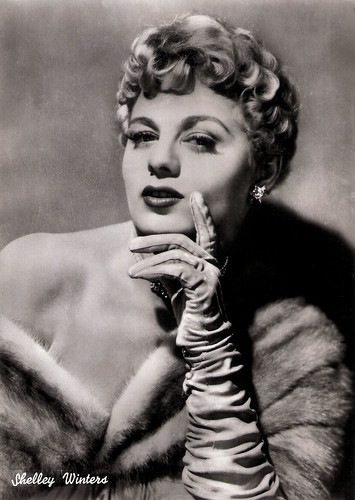
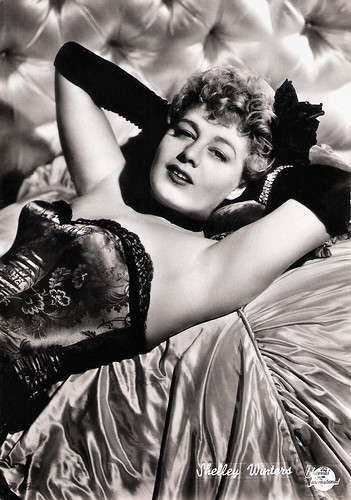
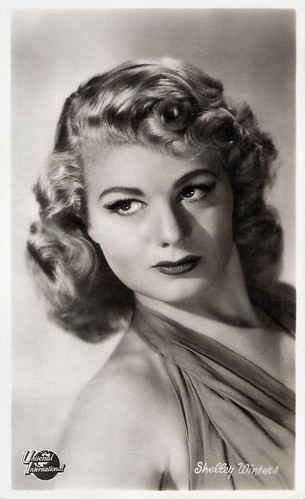
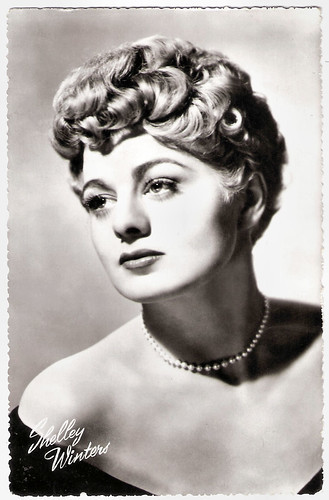
American actress Shelley Winters (1920-2006) appeared in dozens of films, as well as on stage and television. She was a major film presence for six decades, and turned herself from a Blonde Bombshell into a widely-respected actress who won two Oscars, for The Diary of Anne Frank (1959) and A Patch of Blue (1965). Less known, Winters also appeared in several European films, including Alfie 1966 and Roman Polanski's Le Locataire (1976).

Shelley Winters
Italian postcard by Bromofoto, Milano, no. 273.

Shelley Winters
Italian postcard by Bromofoto, Milano, no. 316. Photo: Universal International.

Blonde Bombshell


Shelley Winters was born Shirley Schrift in St. Louis, Missouri, in 1920. She was the daughter of Rose (née Winter), a singer with The Muny, and Jonas Schrift, a designer of men's clothing; her parents were Jewish immigrants. Her family moved to Brooklyn, New York when she was three years old. Winters studied at The New School in New York City, where she appeared in high school plays.

Her first film was What a Woman! (Irving Cummings, 1943) starring Rosalind Russell. Throughout the 1940s, she mostly played bit roles and studied in the Hollywood Studio Club. In the late 1940s, she shared an apartment with another newcomer, Marilyn Monroe.

Winters achieved stardom with her breakout performance as the the party girl waitress who ends as the victim of insane actor Ronald Colman in A Double Life (George Cukor, 1947). She quickly ascended in Hollywood with leading roles in The Great Gatsby (Elliott Nugent, 1949) with Alan Ladd, and Winchester 73 (Anthony Mann, 1950), opposite James Stewart.

Universal Pictures built her up as a Blonde Bombshell but she quickly tired of the role's limitations. She washed off her makeup and played against type to set up Elizabeth Taylor's beauty in A Place in the Sun (George Stevens, 1951), still a landmark American film. Her performance brought Winters acclaim and a nomination for the Academy Award for Best Actress.

Throughout the 1950s, Winters continued to star in films, including Meet Danny Wilson (Joseph Pevney, 1952) as Frank Sinatra's leading lady, and most notably in Charles Laughton's Night of the Hunter (1955), with Robert Mitchum and Lillian Gish.

In Great Britain she played in the Christopher Isherwood adaptation I Am a Camera (Henry Cornelius, 1955) opposite Julie Harris and Laurence Harvey, and in Italy in Mambo (Robert Rossen, 1954) opposite Silvana Mangano and Winters' second husband Vittorio Gassman.

She also returned to the stage on various occasions during this time, including a Broadway run in A Hatful of Rain (1955–1956), opposite future, third husband Anthony Franciosa. Although she was now in demand as a character actress, Winters continued to study her craft. She attended Charles Laughton's Shakespeare classes and worked at the Actors Studio, both as student and teacher.

Shelley Winters
Belgian collectors card by De Beukelaer, Anvers, no. A 7. Photo: Universal International.

Shelley Winters
Dutch postcard by DRC, no. F 210. Photo: M.G.M.

Bloody Mama


In 1960, Shelley Winters won an Oscar for Best Supporting Actress for The Diary of Anne Frank (George Stevens, 1959), and six years later, she won another Oscar, in the same category, for A Patch of Blue (Guy Green, 1965). She donated her Oscar for The Diary of Anne Frank to the Anne Frank House in Amsterdam.

Notable roles during the 1960s included her lauded performance as the man-hungry Charlotte Haze in Stanley Kubrick's Lolita (Stanley Kubrick, 1962); starring opposite Michael Caine in Alfie (Lewis Gilbert, 1966), and as the fading, alcoholic former starlet Fay Estabrook in Harper (Jack Smight, 1966).

The following decade she could be seen in The Poseidon Adventure (Ronald Neame, 1972) as the ill-fated Belle Rosen (for which she received her final Oscar nomination), and in Next Stop, Greenwich Village (Paul Mazursky, 1976). Winters also starred in interesting European films like Roman Polanski’s thriller Le Locataire/The Tenant (1976) with Isabelle Adjani, and Mario Monicelli’s drama Un borghese piccolo piccolo/A Very Little Man (1977) with Alberto Sordi.

She returned to the stage during the 1960s and 1970s, most notably in Tennessee Williams' Night of the Iguana. She appeared in such cult films as Wild in the Streets (Barry Shear, 1968), Bloody Mama (Roger Corman, 1970) and Whoever Slew Auntie Roo? (Curtis Harrington, 1971). She also starred in the Broadway musical Minnie's Boys (1970) as Minnie Marx, the mother of Groucho, Harpo, Chico, Zeppo, and Gummo Marx.

During her 50 years as a widely known personality, Winters was rarely out of the news. Her stormy marriages, her romances with famous stars, her forays into politics, and feminist causes kept her name before the public. She delighted in giving provocative interviews and seemed to have an opinion on everything. That led to a second career as a writer. She recalled her conquests in her autobiographies, like Shelley Also Known As Shirley, and wrote of a yearly rendezvous she kept with William Holden, as well as her affairs with Sean Connery, Burt Lancaster, Errol Flynn, Farley Granger and Marlon Brando.

Winters gained significant weight later in life, but lost much of it for (or before) an appearance at the 1998 Academy Awards telecast, which featured a tribute to Oscar winners past and present. In a recurring role in the 1990s, Winters played the title character's grandmother on the ABC sitcom Roseanne.

Her final film roles were supporting ones: she played a restaurant owner and mother of an overweight cook in Heavy (James Mangold, 1995), with Liv Tyler and Debbie Harry, and as an aristocrat in The Portrait of a Lady (Jane Campion, 1996), starring Nicole Kidman and John Malkovich. Her final film was the Italian comedy La bomba (Giulio Base, 1999) with her former husband Vittorio Gassman (whose last film this was too) and his son Alessandro Gassman.

Winters was married four times; her husbands were: Captain Mack Paul Mayer, whom she married on New Year's Day, 1942; they divorced in October 1948. Winters wore his wedding ring up until her death, and kept their relationship very private. In 1952, she married Vittorio Gassman. They divorced in 1954 and had one child, Vittoria (1953), a physician, who practices internal medicine at Norwalk Hospital in Norwalk, Connecticut. She was Winters' only child. Later husbands were Anthony Franciosa (1957-1960) and long-time companion Gerry DeFord, whom she married hours before her death in 2006.

Shelley Winters died at the age of 85 on January 14, 2006, of heart failure at the Rehabilitation Centre of Beverly Hills.


Trailer for Lolita (1962). Source: AgelessTrailers (YouTube).


Trailer for Bloody Mama (1970). Source: Behind The Science Fiction (YouTube).

Sources: Gary Brumburgh (IMDb), Wikipedia, and IMDb.